
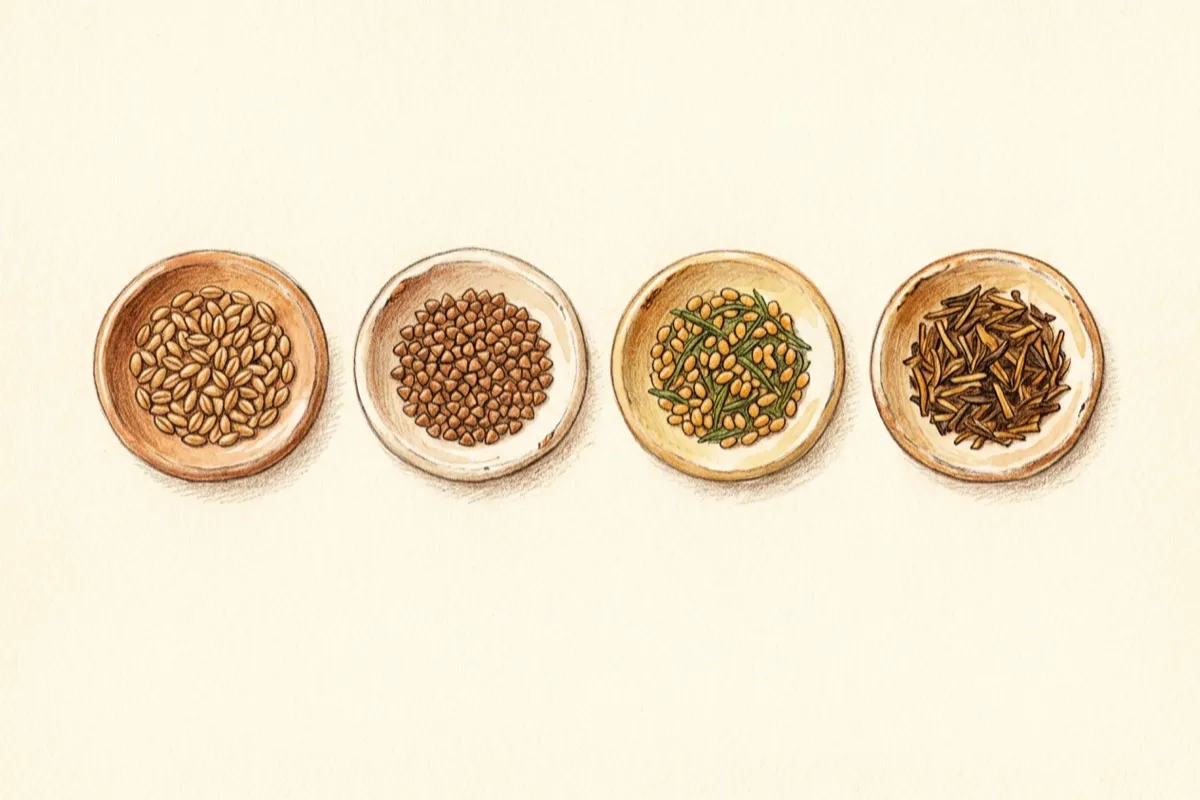
Cold mugicha waits in the fridge, sobacha comes with a meal at a soba shop, and genmaicha sits in the teapot. All are toasty “teas,” yet what each one roasts is not the same.
This piece lines up barley, buckwheat seeds, rice and tea leaves in the order they are made, and follows how roasting reaches well beyond hojicha.
Barley roasted, then broken
Shake a tea bag, and fine grains rustle inside. In mugicha, roasting and sizing the grain are separate steps.
According to a mugicha maker, the materials are small-grain barley, large-grain barley and naked barley. Selected barley goes into a roaster and is roasted through to the centre. For tea bags, the roasted barley is then broken into suitable pieces before packing.
Looking only at the grains in a bag, this sequence is easy to miss. The sources say this much: the barley is roasted first, then shaped into the form used for the drink. Next is barley roasted together with sand.
Barley roasted with sand
Picture barley tumbling through hot sand in a kiln. Sand roasting is used not only for tea leaves but for barley too.
Much as beach sand holds the sun’s heat, here the barley is roasted in heated sand. A company using domestic barley publishes a process in which barley and silica sand go into kilns, roasted briefly at a different temperature in each of two kilns. Anyone who knows sand-roasted tea will see the connection.
Another company describes roasting a few times across a wider temperature range, but these figures belong to each company’s machines. They are not a shared table for ranking hotter as deeper, or for copying onto a home frying pan. After barley come buckwheat seeds.
An amber tea of buckwheat
Poured into a cup, sobacha glows a clear amber. What sobacha roasts is buckwheat seed, not tea leaf.
A buckwheat miller describes sobacha as a grain tea made by roasting buckwheat seeds. It notes a mellow taste and a toasty aroma. Like mugicha, it is not made from the leaves of the tea plant.
The sources take us this far: “tea” in a name does not guarantee tea leaves. Tea leaves and grain finally meet in the next one, genmaicha.
Roasted rice in with the leaves
Look into a bag of genmaicha, and golden-brown grains of rice lie among the green leaves. Genmaicha has one step for roasting the rice and another for combining it with tea.
A tea company explains that rice is soaked, steamed and then roasted, before bancha, sencha or similar tea is added in roughly equal measure. Hojicha draws out its toasty character by roasting the leaves themselves. In genmaicha the toastiness comes from the roasted rice, which shares the bag with the leaves.
The sources say only that the roasted part sits in a different place in each toasty tea. Last, it helps to line up all four by what is done to them.
Four bags, sorted by verbs
On the kitchen shelf stand bags of mugicha, sobacha, genmaicha and hojicha. Sorting them by what was done, rather than by name, makes the differences easier to see.
Mugicha roasts barley, and sobacha roasts buckwheat seeds. Genmaicha combines roasted rice with tea leaves, and hojicha roasts the tea leaves. They may smell alike while their materials differ, and different materials are still joined by roasting.
When tasting them side by side, the ingredients and method come first, and putting the aroma into words comes after. Then the everyday shelf starts to look like a set of familiar food-making techniques. Company names and figures are gathered below.
The numbers in detail
- Mugicha materials
- According to Marubishi’s guide to barley tea, the materials are small-grain barley, large-grain barley and naked barley.
- Mugicha process
- Selected barley is roasted through to the centre in a roaster. For tea bags, the roasted barley is crushed to a suitable size before packing.
- Marubishi’s temperatures
- The company also describes roasting generally at 200–280°C, two or three times.
- Sand roasting
- Ogawa Sangyo publishes a process using domestic six-row barley. Barley and silica sand go into the first kiln at 250°C for one minute, then the second kiln at 150°C for one minute.
- Sobacha
- Nikkoku Seifun describes it as a grain tea of roasted buckwheat seeds, with an amber liquor, a mellow taste and a toasty aroma.
- Genmaicha
- From Ito En’s tea encyclopedia. Rice is soaked, steamed and roasted, then bancha, sencha or similar tea is added in roughly equal proportion.
- Reading the figures
- These temperatures and times belong to each company’s machines and processes. They are not a shared scale of roast depth.