An unglazed horoku sits on the kitchen hob. Its handle is a hollow tube, and it is lighter in the hand than it looks. A day with the horoku and a day with the frying pan bring the heat in differently.
What follows are two methods published by tea sellers, the horoku and the frying pan, taken through in order up to the point where the leaf has cooled.
A horoku or a frying pan
Held over the flame, the clay base of the horoku warms slowly. Roasting at home comes down to two ways: the horoku or the frying pan.
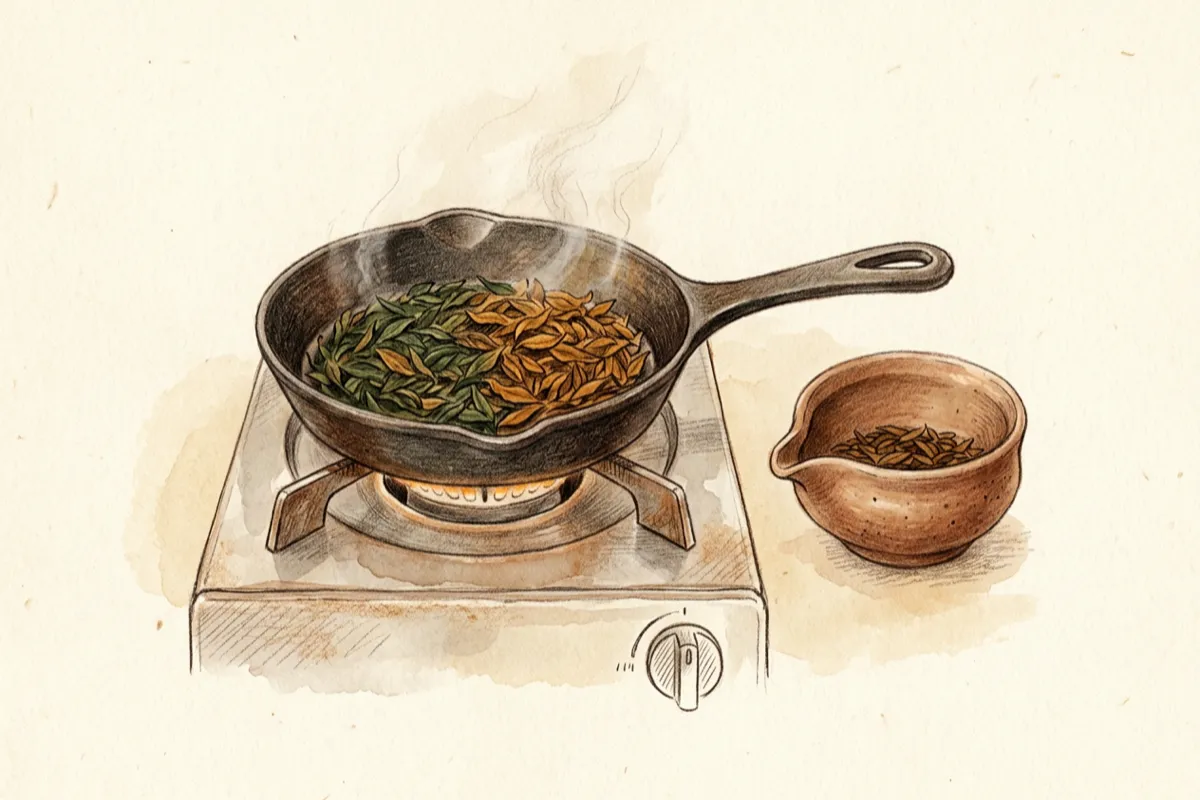
A horoku is held by its handle with its contents over the flame. To roast evenly, it is swung from the wrist so the contents roll. With a frying pan, the tea is dried over medium heat, cooled, then roasted over high heat.
Choose one and follow it to the end. A horoku is not set down and left, so the grip and the swing are best found before the leaf goes in. After the tools come the horoku's four steps.
Four steps with the horoku
As the horoku heats, a faint warmth reaches the palm. Its method has four steps, and the end is judged by smoke and the leaf's colour, not by the clock.
In one tea farm's method, the horoku is first warmed over medium heat for 30 seconds to 1 minute. Then 5 to 10 grams of leaf go in and are kept moving so they do not scorch. When smoke appears, the finish is near. At the roast you like, the leaf is tipped out through the hollow handle.
The preheating time is not the roasting time. Tools and flames differ from kitchen to kitchen, so this is not a setting to carry over unchanged. The record supports only the guide figures for this horoku method. After the horoku comes the frying pan's two stages.