Japan Hojicha AssociationJapan Hojicha Association

Tea gets more interesting with roasting.

Why Kaga bocha is made from stems

Chapter 7 · 3 of 4 sections readable now

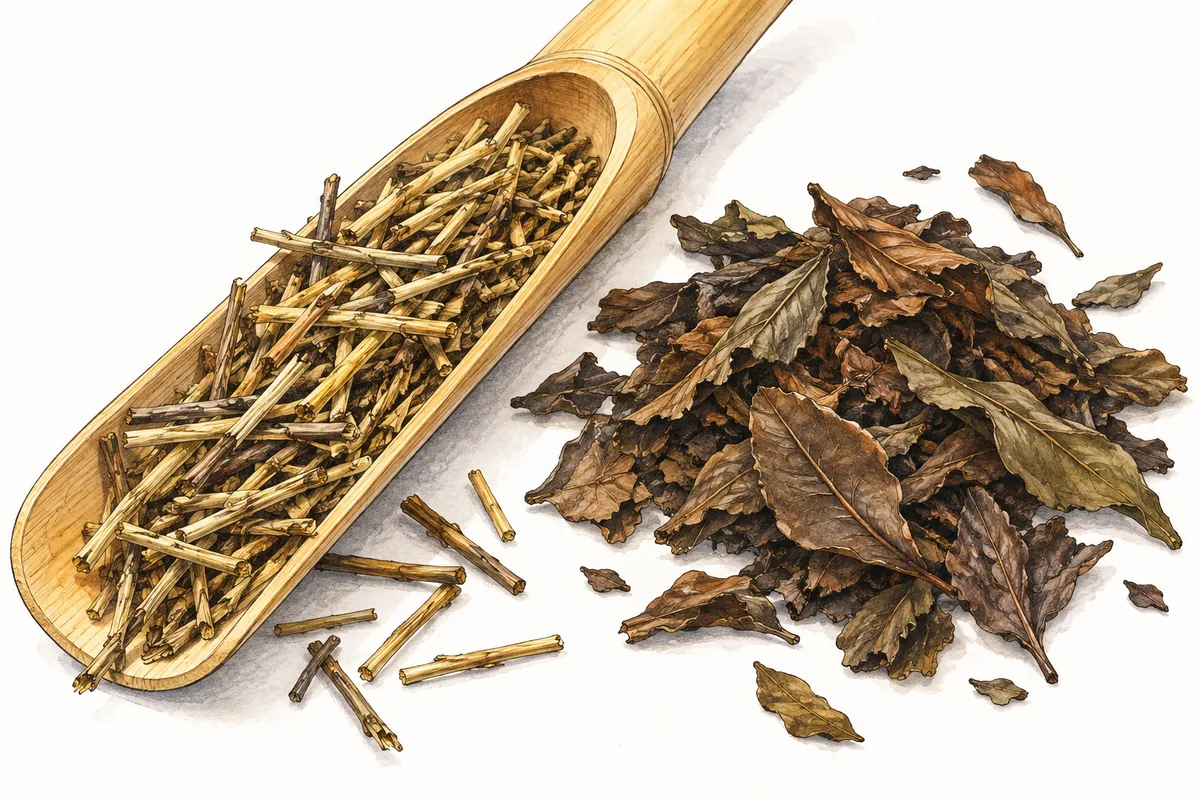
An illustration contrasting slender stems on a bamboo tea scoop with broad tea leaves spread beside it.

Why Kaga bocha is made from stems, starting from how leaves and stems differ inside.

01Members only

How leaves and stems differ inside

Hojicha starts from leaves, stems, or both. In the Kaga bōcha process described by Japan’s ministry, the stems are separated before roasting, not by it.

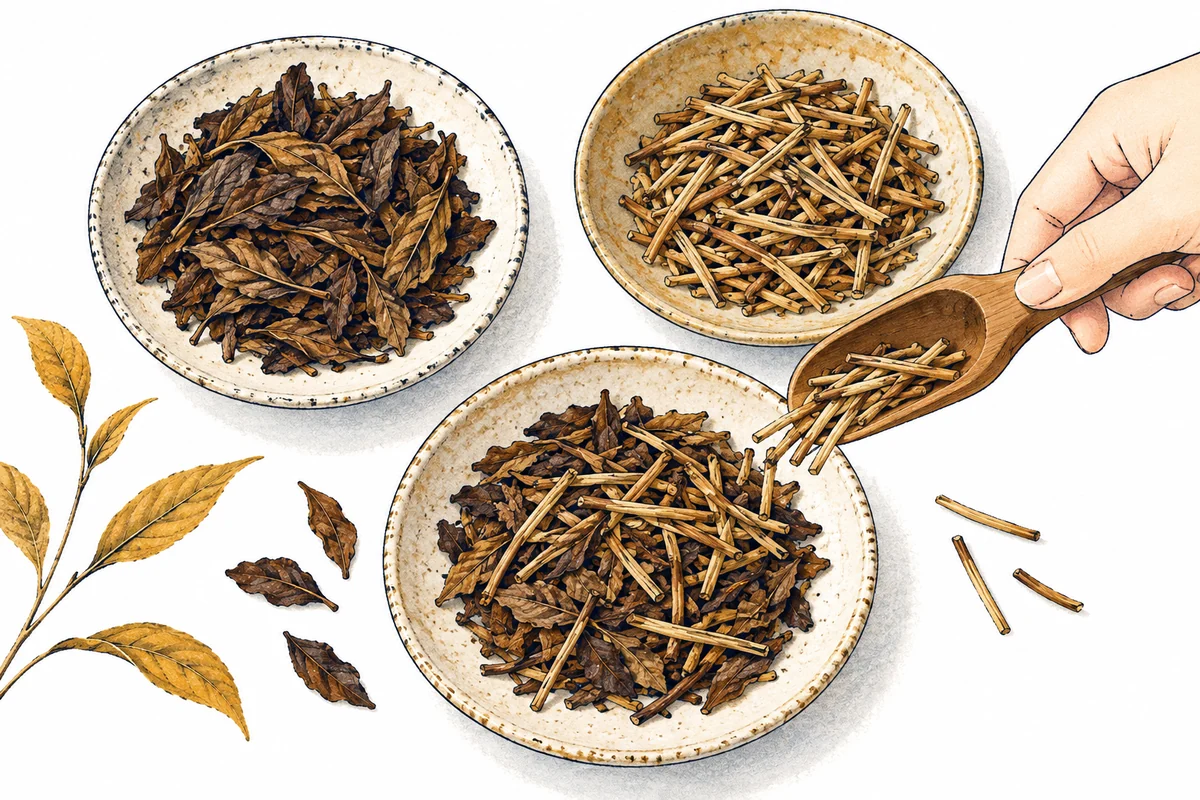
Illustration comparing leaf hojicha, stem hojicha and a mixture of leaves and stems on three dishes

Open a packet of hojicha and you may find mostly leaves or mostly slender stems. Products on the same hojicha shelf do not necessarily begin with the same material before roasting.

Product examples and research offer ways to explore those differences. Rather than deciding whether stems or leaves are better, the starting point is to identify what is actually being compared.

Leaves or stems: what a packet of hojicha actually starts from

Hojicha does not start from one material. Tea roasted from leaves, tea roasted from stems and tea combining the two all sit on the same hojicha shelf. And in the Kaga bōcha process described by Japan’s ministry, the stems are separated before roasting, after the unrefined tea has been made.

Three things follow from that. One maker can use leaves for one product and stems for another. In the Kaga bōcha process described by the ministry, stems are not separated by the roasting: they are selected after steaming, rolling and drying have produced the unrefined tea. And when the Industrial Research Institute of Ishikawa roasted stems and leaves under the same conditions, their aroma compounds differed in composition.

Maruhachi Seichajo uses leaves for its Kaga Hojicha and stems for its Kenjō Kaga Bōcha. Sharing a maker does not mean sharing the same ingredients. Put the product names side by side, then check what each contains: it changes where the comparison begins.

If they taste different, that difference cannot automatically be put down to roast level alone. These products are made from different materials. Before asking how deeply a tea was roasted, there is another question: what was roasted?

In Kaga bōcha, stems are selected before roasting

The material used here is the product descriptions of Maruhachi Seichajo and Marukyu Koyamaen, the Kaga bōcha process described by the Ministry of Agriculture, Forestry and Fisheries, joint research presented by the Industrial Research Institute of Ishikawa, and a 1999 paper on tea aroma. The research compares samples under matching conditions, whereas commercial products differ in processing as well as material. None of it ranks stems above leaves or the reverse.

In the Kaga bōcha process described by Japan’s Ministry of Agriculture, Forestry and Fisheries, steaming, rolling and drying produce aracha, or unrefined tea. The stems are then separated and roasted. Leaves and stems are selected before roasting, rather than being separated by the roasting itself.

This process collects the stems mixed into the tea material and puts them to use. When drinking bōcha, tracing the work back beyond roasting to that separation makes the choice of stems more concrete.
The remaining three sections cover products that combine leaves and stems, such as Gosho Kaori, why matching roasting conditions do not produce matching aromas, and how heating conditions change with the material.

The rest of this article is for members.

Membership is available in Japanese. It takes an email address and a password, and it is free.

Open the Japanese membership page

Updated 22 September 2026This section on its own page

02Members only

Why stems are given a lighter roast

Kukicha and bōcha contain stems separated before roasting. The stems held about 1.5 times the amino acids of leaves, and different heating suits each.

An illustration contrasting slender stems on a bamboo tea scoop with broad tea leaves spread beside it.

The slender stems of bōcha and the leaves of leaf hojicha look different as soon as you peer into the teapot. But the two were separated much earlier, before roasting.

We look in turn at labelling standards, regional accounts, and two reports: how kukicha and bōcha are defined, how their components differ before roasting, and how heating conditions have differed for stems and leaves.

What are kukicha and bōcha, and how do they differ from leaf hojicha?

Kukicha and bōcha are teas containing a high proportion of tea stems and leaf stalks selected during the finishing of aracha, or unrefined tea. Not stems alone. They part from leaf hojicha before roasting, so their contents already differ when the heat is applied.

Three figures set the two apart. Before roasting, the Industrial Research Institute of Ishikawa found about 1.5 times as much amino acid in the stems as in the leaves. When stems and leaves from the same tea plants were roasted under the same conditions, the pyrazine with the highest aroma indicator was about 1.4 times as abundant in bōcha as in leaf hojicha, and geraniol and linalool about four times — amounts of each compound, not how much stronger the aroma smells. And a 1999 paper found 150°C for 12 minutes suitable when stems are included, and 130°C for 10 minutes for leaves alone.

The Japan Tea Central Association’s green tea labelling standards define “kukicha or bōcha” as tea containing a high proportion of stems and leaf stalks selected during the finishing of aracha, or unrefined tea, using stem-separating machines and similar equipment. The definition says a high proportion, rather than stems alone.

According to Maruhachi Seichajo in Kaga City, Ishikawa, plucking methods such as “one bud and four leaves,” which take leaves down to the fourth from the tip, include stems in the harvest. Steaming and rolling separate the leaves and stems: leaves become sencha or gyokuro, while stems become kukicha or bōcha. In some regions, these are also called karigane or shiraore.

The meaning of a name shifts by place. The company writes that in Kaga City, “bōcha” often means roasted tea made from stems, while nationally it seems more often to mean green tea made from stems. Whether the tea is roasted may or may not be implicit in the name.

Stems and leaves differ before roasting

The figures above come from joint research by the Industrial Research Institute of Ishikawa with Ishikawa Prefectural University and Maruhachi Seichajo, and from a 1999 paper in the journal of the Japan Society for Bioscience, Biotechnology, and Agrochemistry. The first compared stems and leaves from the same tea plants roasted under the same conditions, and what it reports is the amount of each compound, not how much stronger a person finds the aroma. The temperatures and times in the second are likewise results for the tea and equipment used in that test.

Maruhachi Seichajo explains tea’s taste mainly in terms of three components: catechins, which bring astringency and bitterness; amino acids, which bring umami; and caffeine, which brings bitterness. Leaf tea has all three, giving a pronounced taste in which bitterness, astringency, and umami are balanced. Stem tea has less catechin and caffeine but more amino acids, so it has milder bitterness and astringency, with a clean taste and noticeable umami.

A report from the Industrial Research Institute of Ishikawa also compares the amino acid content of stems and leaves before roasting. The stems contained about 1.5 times as much. Amino acids in the tea plant have been reported to turn into catechins in the leaves; the report suggests that more may remain in stems because this reaction occurs less there.

Pyrazines that create roasted aromas arise through the Maillard reaction between amino acids and sugars. The greater supply of starting materials in stems is offered as an explanation for differences after roasting.

The remaining five sections cover the same-plant comparison checked against 10 commercial bōcha and 6 leaf hojicha, the aromas roasting subtracts, how producing regions describe the work, and drinking stems and leaves differently at home.

The rest of this article is for members.

Membership is available in Japanese. It takes an email address and a password, and it is free.

Open the Japanese membership page

Updated 22 September 2026This section on its own page

03Members only

Kaga bocha as a way of making tea

A light roast is not roasting cut short. Maruhachi Seichajo’s Kenjō Kaga Bōcha lightly roasts first-picking stems for aroma and a clean cup.

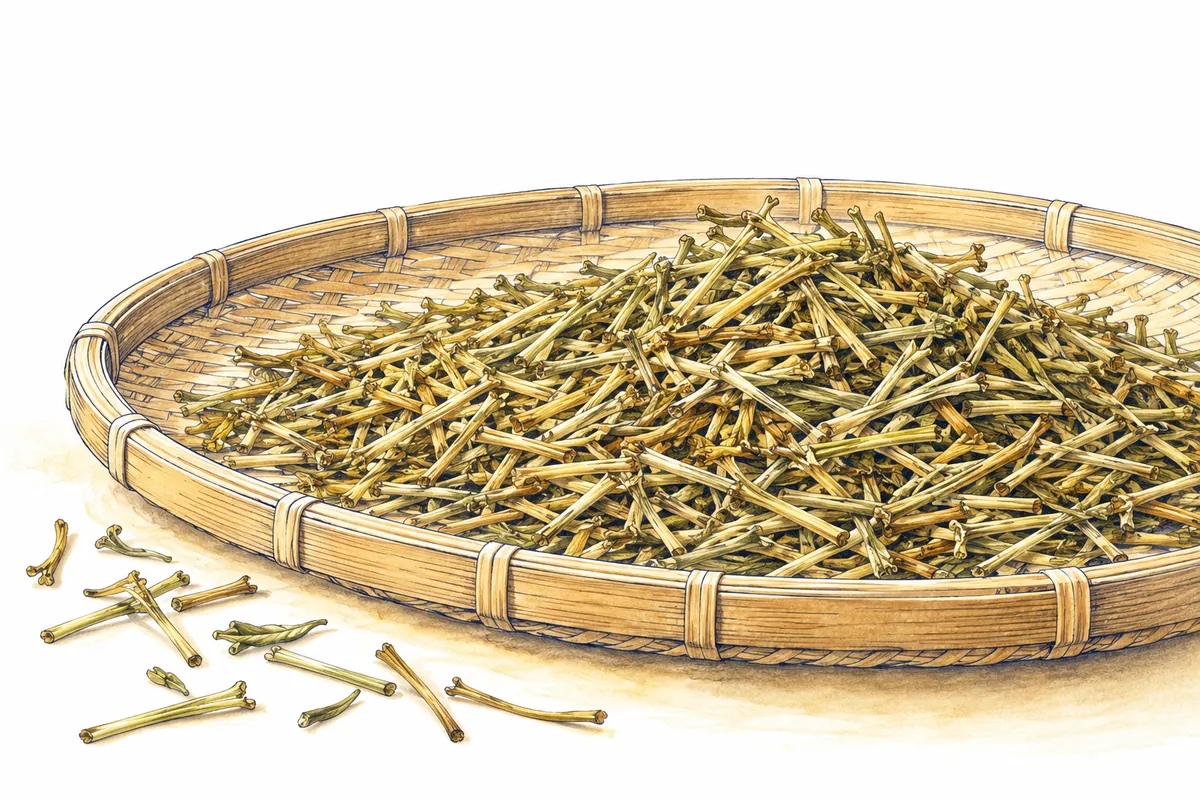
An illustration of slender, pale golden tea stems spread across a shallow bamboo sieve.

Does deeper-roasted hojicha always have a richer aroma? Maruhachi Seichajo’s Kenjō Kaga Bōcha describes the taste it aims for through light roasting. Its companion product Hojitate is also a stem tea from the same shop, but roast depth is not the only difference. Looking at materials and heating together helps explain the choice of a light roast.

What a light roast means for Kaga bōcha, and why it is not simply less roasting

A light roast does not mean tea whose roasting was stopped part-way. Maruhachi Seichajo says it developed a new light roast that keeps a toasty aroma while giving a clean, refreshing cup. Roast depth reads as a choice about the cup to create, not as a measure of whether the tea was roasted enough.

Three things are set out in the product description. Kenjō Kaga Bōcha lightly roasts stems from the first picking. The roasting is described as using far-infrared ceramic burners, with experienced staff adjusting them to the day’s material. And the same shop’s Hojitate blends stems from the first and second pickings, so the blend of materials differs as well as the roast depth.

Maruhachi Seichajo says it developed a new light roast that retains a toasty aroma while giving a clean, refreshing cup. Kenjō Kaga Bōcha lightly roasts stems from the first picking. Making roasted aromas as strong as possible is only one way to finish tea.

“Light” might suggest simply stopping the heat early. But this product’s description sets out a goal: both a toasty aroma and a clean drinking experience. Roast depth can be read as a choice about the cup to create, rather than a measure of whether the tea has been roasted enough.

The “bō” in bōcha means stems

This article rests on two product descriptions published by Maruhachi Seichajo itself, and on the stem-and-leaf roasting comparison presented by the Industrial Research Institute of Ishikawa. The descriptions set out what each tea aims at; the research sets out how the compounds differed when stems and leaves were roasted under the same conditions. Neither product description gives a temperature or a time.

The “bō” in bōcha refers to the stems used as its material. Research described by the Industrial Research Institute of Ishikawa found differences in aroma composition even when stems and leaves were roasted under the same conditions. Matching the heating does not erase differences in the materials.

This was joint research with Ishikawa Prefectural University and Maruhachi Seichajo, and the comparison is limited to its samples and conditions. It cannot establish that every stem tea is more aromatic than leaf tea, but it offers a reason to see bōcha as more than hojicha in a different shape.

The remaining three sections cover adjusting the same light roast to each day’s material, the two ways Hojitate differs, and separating aroma from the drinking experience when comparing them.

The rest of this article is for members.

Membership is available in Japanese. It takes an email address and a password, and it is free.

Open the Japanese membership page

Updated 22 September 2026This section on its own page

1 more section will follow.

Back to the contents