Japan Hojicha AssociationJapan Hojicha Association

Tea gets more interesting with roasting.

What 'not astringent' means, in terms of compounds

Chapter 8 · 2 of 4 sections readable now

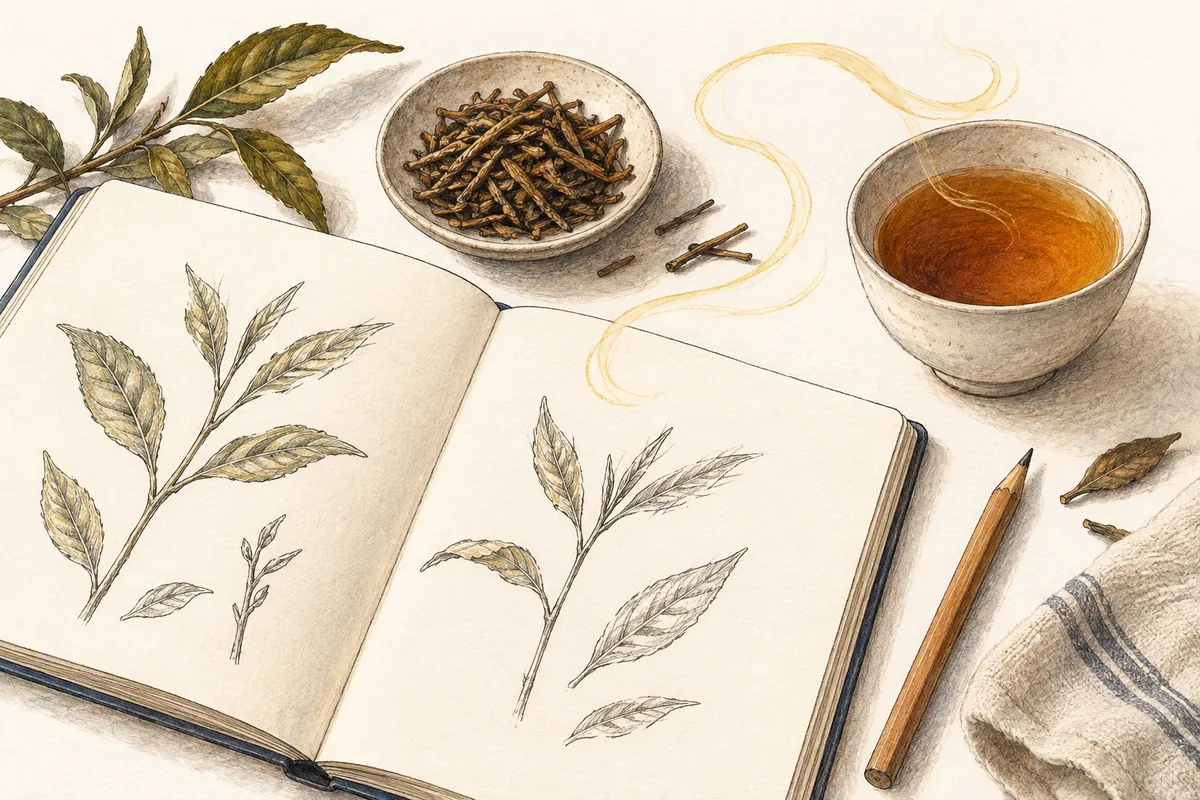
Illustration of hojicha with curved lines representing its aroma and an open notebook containing sketches of tea leaves

Impressions such as 'not astringent' and 'toasty', put into the language of compounds.

02Members only

Which compounds carry the aroma

Reports on hojicha’s aroma go back to 1973, when 21 pyrazines were found in it. Ranking compounds by quantity, though, does not rank aroma strength.

Illustration of hojicha with curved lines representing its aroma and an open notebook containing sketches of tea leaves

How much work does it take to describe the aroma rising from a cup in the names of compounds? From a researcher’s perspective, it is a long process of separating, smelling and counting.

Reports from 1973 onwards trace ways of extracting aroma and examining it with human noses and chemical analysis. For each, we look at what was used, what was measured and how far the conclusions extended.

How has hojicha’s aroma actually been studied?

Reports on hojicha’s aroma go back at least to 1973, when a comparison of green tea with hojicha roasted at 200°C for several minutes reported 21 pyrazines in hojicha and substantial increases in them through roasting. The broad outlines of that aroma were drawn half a century ago.

The reading goes in three stages. A list of compounds changes with the extraction method, so the figures have to be read together with how they were obtained. Aroma strength does not correlate with gas-chromatogram peak size, so quantity cannot identify the strongest-smelling compounds. And AEDA is used alongside it: an aroma extract is diluted in stages and the greatest dilution at which a human nose still detects a compound becomes its FD factor.

According to a review by the Industrial Research Institute of Ishikawa, Yamanishi and colleagues compared aroma compounds in green tea with those in hojicha roasted at 200°C for several minutes. In 1973, they reported 21 pyrazines in hojicha and substantial increases in those compounds through roasting. In the same year, Hara and colleagues reported that hojicha contained many pyrazines, pyrroles and furans formed during roasting.

A 1999 paper also recounts that Yamanishi and colleagues identified 66 compounds in hojicha aroma. The broad outlines of that aroma had already been drawn half a century ago.

Change the extraction method and the compound list changes

The sources drawn on here are a review and a bōcha study from the Industrial Research Institute of Ishikawa, a 1999 paper in the journal of the Agricultural Chemical Society of Japan, a 2018 metabolomics paper on roasted stem tea, a NARO report, and a Grants-in-Aid research report. Samples and extraction methods differ from report to report, and so do the dilution steps. Each study’s FD factors therefore stand on their own.

The 1999 paper describes drawbacks in the SDE and reduced-pressure distillation methods previously used to prepare tea aroma concentrates: water-soluble volatile compounds were difficult to recover, and components in the leaves could change during sample preparation. It judged these methods unsuitable for investigating the aroma pattern encountered when drinking tea, and instead extracted the infusion with an organic solvent.

When the National Agriculture and Food Research Organization (NARO) examined roasted tea, it obtained 0.1 mL of aroma extract from 200 g of tea using reduced-pressure and high-vacuum distillation, then diluted it 10-, 100-, 1000- and 10000-fold with dichloromethane. In the Industrial Research Institute of Ishikawa’s bōcha research, a stir bar was placed in the extract to adsorb compounds, which were then released by heating. For comparisons among commercial products, compounds were collected for 30 minutes from the air in a vial containing 0.5 g of ground tea warmed to 80°C.

The question is not simply which method is right: the methods differ in what they can extract. Reading a list of compounds also means considering the extraction method that produced it.
The remaining five sections cover the compound with the highest FD factor and its figure, aromas newly formed as against aromas released from existing bonds, how preference has been connected to the figures, and the limits each study states.

The rest of this article is for members.

Membership is available in Japanese. It takes an email address and a password, and it is free.

Open the Japanese membership page

Updated 22 September 2026This section on its own page

03

How quickly a fresh roast loses its aroma

Maruhachi Seichajo names air, moisture, light and temperature change as what harms tea. Close the bag once opened and drink it before long.

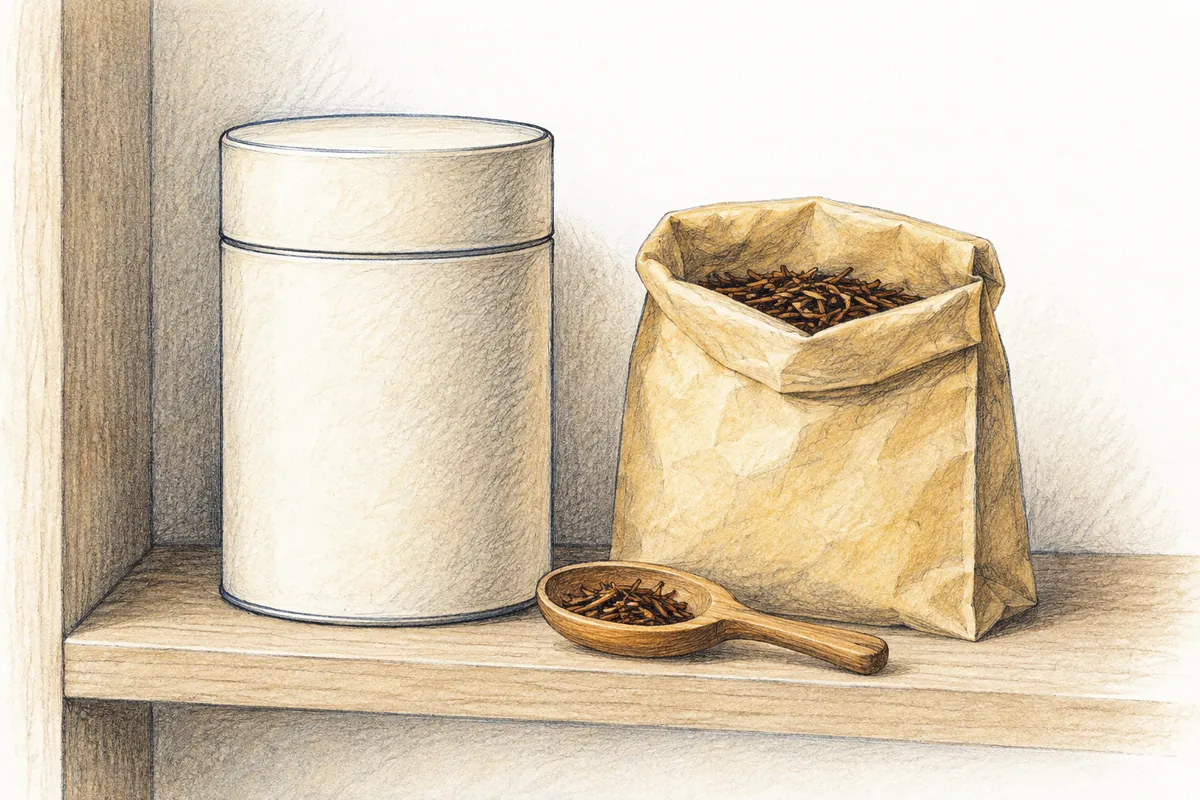
An illustration of a lidded tea tin, an open packet of tea, and a tea scoop on a shelf.

You love the aroma when you open the bag, and the more special the tea, the more tempting it is to save it a little at a time. But storing it for a long time and enjoying the flavour you love are different aims. Following the merchant’s work before shipment and your handling at home takes us beyond the words “freshly roasted” to the daily act of closing the bag.

How to store hojicha: keeping it from air, moisture, light and temperature change

For dry tea leaves, the first things to keep away are air, moisture, light and changes in temperature. Close the bag once opened and finish the tea before long. Simply moving it away from direct sunlight, from sources of heat or steam and from strongly scented things already settles the storage spot.

There are three things to check. Maruhachi Seichajo lists air, moisture, light and temperature change as what harms flavour, and Ippodo Tea advises keeping dry tea away from sunlight, heat, moisture and strong odours; both say to close the bag once opened. This concerns dry tea leaves; storing brewed tea is a separate question to check. And roasting is sometimes timed to shipment, so heating and packing are designed as one continuous piece of work.

Bashoen Chaho says experienced staff decide how to apply heat just before shipment, taking into account the weather, temperature, and tea’s condition. It then carries out a second roasting and encloses the easily volatilized aroma in individual packaging. Heating and wrapping are part of one sequence of work.

The point is more than the number “twice.” It is the order: roasting to match shipment, then packaging. The process that creates the aroma and the process that delivers it have been designed together.

Storing tea at home starts with the spot and the closed bag

The advice below is published by Maruhachi Seichajo, Ippodo Tea and Bashoen Chaho respectively. All three set out where to keep tea, how to close the bag and how soon to drink it. None of them gives a figure for how long tea keeps, or measurements of how its taste changes.

Maruhachi Seichajo lists air, moisture, light, and temperature changes as factors that impair tea’s flavour, advising that the bag be sealed after opening and the tea enjoyed promptly. Ippodo also advises keeping dry tea away from sunlight, heat, moisture, and strong odours, with the bag closed. This storage advice concerns dry tea; storage of brewed tea needs to be checked separately.

Look beyond whether tea is on a shelf to the shelf’s surroundings. Does direct sunlight reach it? Is it right beside a source of heat or steam? Is it stored with strongly scented things? Relating storage conditions to actual places in your kitchen helps you find things to improve.

After taking out tea, close the bag before continuing with other preparations. Writing the opening date on the bag can also show which one you opened first. This does not set a new quality deadline; it helps you decide which opened tea to enjoy next.

Compare aroma from the bag with the brewed cup

For observations at home, try recording the aroma when you open the bag separately from your impressions after brewing. If they differ, do not assign the cause to storage alone; also look back at the amount of tea and the brewing method. This makes it easier to check your own handling than comparing aromas from memory alone.

Updated 22 September 2026This section on its own page

2 more sections will follow.

Back to the contents