Japan Hojicha AssociationJapan Hojicha Association

Tea gets more interesting with roasting.

Reading the bag: what 'light' and 'dark' roast tell you

Chapter 6 · 2 of 5 sections readable now

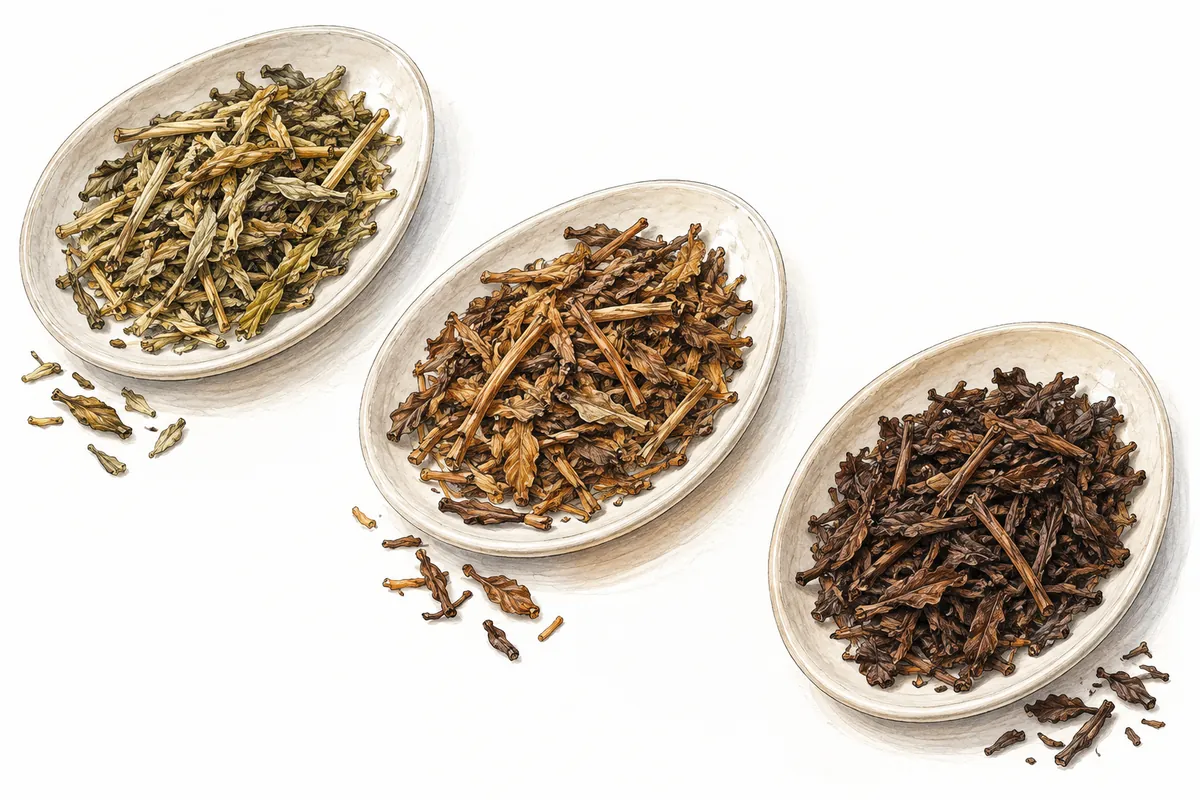
Illustration of tea in three shallow dishes, with colours ranging from bright gold to dark brown.

How much the words 'light roast' and 'dark roast' on a bag really tell you about what is inside.

01Members only

There is no industry-wide definition of 'light' or 'dark' roast

Light, medium and dark roast are not names in the Japan Tea Central Association’s standard, which settles 17 names such as hojicha. Shops write the rest.

Illustration of tea in three shallow dishes, with colours ranging from bright gold to dark brown.

Turn a tea packet over and you will often see a small printed table: name, ingredients, net weight and best-before date. Words such as light roast and dark roast usually appear outside that table, in the product name or description.

There is a reason for the different placement. The standards governing what is written on the packet and the explanations a shop gives in its own words operate on different levels. Let’s compare four tea merchants’ descriptions, alongside public information and coffee’s roast categories.

Who decides what light, medium and dark roast mean for hojicha?

Light, medium and dark roast are not names set out in the industry’s green-tea labelling standard. The Japan Tea Central Association’s standard settles names such as hojicha; roast level is written by each shop in its own words. No reference temperature is stated anywhere.

There are three places the words divide. The Japan Tea Central Association’s standard specifies 17 names for containers and packaging, and light, medium and dark roast are not among them. A shop’s “light roast” is defined against another product in that same shop, so the term does not line up across shops. And a roast-level name is sometimes attached to a difference in the material itself, such as leaves or stems.

The Japan Tea Central Association’s green-tea labelling standard specifies in Table 1 the names to be used on containers and packaging, stating that names must follow that table. The table lists 17 types, including sencha, gyokuro, bancha or kawayanagi, kukicha or bōcha, and genmaicha. Hojicha is one of them, defined as tea made by roasting sencha, bancha or similar teas over strong heat.

The standard does not establish light, medium and dark roast as separate names. A common name or a description of form may be added in parentheses after the name; the example given is “Name: steamed tamaryokucha (guricha)”.

A product’s roast level can be read together with the individual shop’s explanation. The following descriptions show how those explanations differ.

“Light roast” differs from shop to shop

Set out below are the product descriptions published by Ryuhoen, Morinoen and Maiko no Chahonpo, and Maruyasu Chagyo’s press release announcing a new product. All four put the strength of the roast in their own words, and no temperature figure appears in any of them.

Ryuhoen in Ujitawara, Kyoto, says that selecting the raw material is crucial for light roasting. It explains that creating a roasted aroma at as low a temperature as possible brings out the umami distinctive to a light roast. For its dark roast, it selects tea leaves low in caffeine, free amino acids and tannic acid, then roasts them thoroughly at high heat.

Morinoen, a specialist in house-roasted hojicha founded in 1914, describes light roast as tea roasted slowly over low heat while retaining green tea’s umami, bitterness and astringency. It describes dark roasting as the usual method for hojicha: thorough roasting at high temperature removes astringency and bitterness, making the tea clean-tasting and easy to drink.

Maiko no Chahonpo in Kyoto writes its light-roast label as “浅炒り” (asairi). Compared with its darker “Kaori Fumi”, which is roasted thoroughly, the light-roast hojicha is roasted slowly and lightly over low heat. The company says this lighter treatment also lets you enjoy the aroma of karigane, or stem tea.

The descriptions of lighter roasting share references to low heat, low temperature and retaining the aroma of the raw material. None, however, specifies a reference temperature. Even when the same word is used, the comparison is with another product from that particular shop.
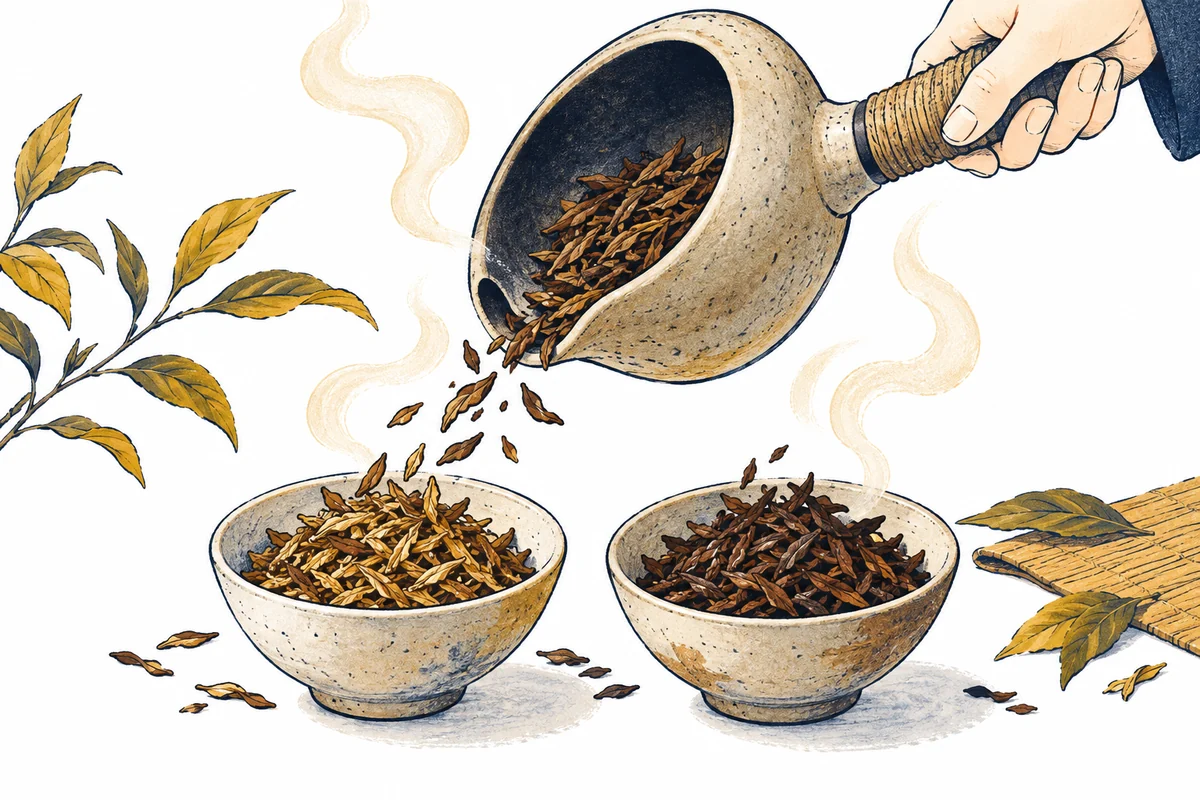
The remaining five sections cover roast-level names paired with stems or leaves, the direction a ministry source gives to the lighter and deeper sides, how a research study drew the lines, and how deep roast means something else in coffee.

The rest of this article is for members.

Membership is available in Japanese. It takes an email address and a password, and it is free.

Open the Japanese membership page

Updated 22 September 2026This section on its own page

05Members only

What the words on the bag tell you before you brew

Marukyu Koyamaen describes light roasts as clean and deep roasts as richly toasted. Across shops, though, the same labels share no common standard.

Illustration of roasting equipment and differently coloured tea leaves showing differences in roasting

Saying “I like light roast” does not mean a tea with the same label from another shop will taste the same. Light and deep can also be words a shop uses to distinguish products within its own range.

Start by comparing two teas from the same maker, then look at another shop. That order changes what you can learn from the descriptions.

How far can light-roast and deep-roast labels on hojicha be compared?

Marukyu Koyamaen describes its lighter-roasted teas in terms of the tea’s own clean character, and its more deeply roasted teas in terms of a rich toasted aroma and a forceful roast character. But light and deep are first of all words a shop uses to tell its own products apart: across shops there is no shared chart of temperatures or times. Reading two products from one maker first is what makes the flavour description usable.

Three things come out of that. First, in Marukyu Koyamaen’s account, a lighter roast keeps the material’s own clean character while a deeper one develops a rich toasted aroma and a forceful roast character. Second, a light roast at one shop and a light roast at another cannot be assumed to share conditions. Third, taking away the roast label, the material and the maker’s flavour description as one set is what helps at the next purchase.

Marukyu Koyamaen gives Gosho Kaori as an example of a lighter finish and Ogura Kaori as an example of a deeper finish. With these two, the words at least belong to the same maker’s account of its different products.

The company describes its lighter-roasted products in terms of the tea’s own clean character, and its more deeply roasted products in terms of a rich toasted aroma and a forceful roast character. Alongside words of degree such as light and deep are words about flavours retained and aromas developed. Reading those specific descriptions makes it easier to imagine which tea you would like to try.

Light roast is not a shared standard across shops

The descriptions compared here are published by Marukyu Koyamaen, Maruhachi Seichajo and Ippodo Tea themselves. All three put the finish in their own words, and none of them gives a temperature or a time.

Maruhachi Seichajo presents Kenjō Kaga Bōcha as lightly roasted, while Ippodo Tea describes its Kuki Hojicha as deeply roasted. Both explain a finished product, but they are not labels based on one shared chart of temperatures or times.

Taking “light roast” on its own therefore does not establish that a tea was made under the same conditions as another company’s light roast. Reading the product name, starting material and flavour description together is more useful when choosing.

The remaining two sections cover how NARO’s research reads the shift in aroma during roasting, and how to take three things — the roast label, the material and the flavour description — away from one packet.

The rest of this article is for members.

Membership is available in Japanese. It takes an email address and a password, and it is free.

Open the Japanese membership page

Updated 22 September 2026This section on its own page

3 more sections will follow.

Back to the contents