Japan Hojicha AssociationJapan Hojicha Association

Tea gets more interesting with roasting.

Roasting and final firing: the same heat, two different steps

Chapter 5 · 3 of 5 sections readable now

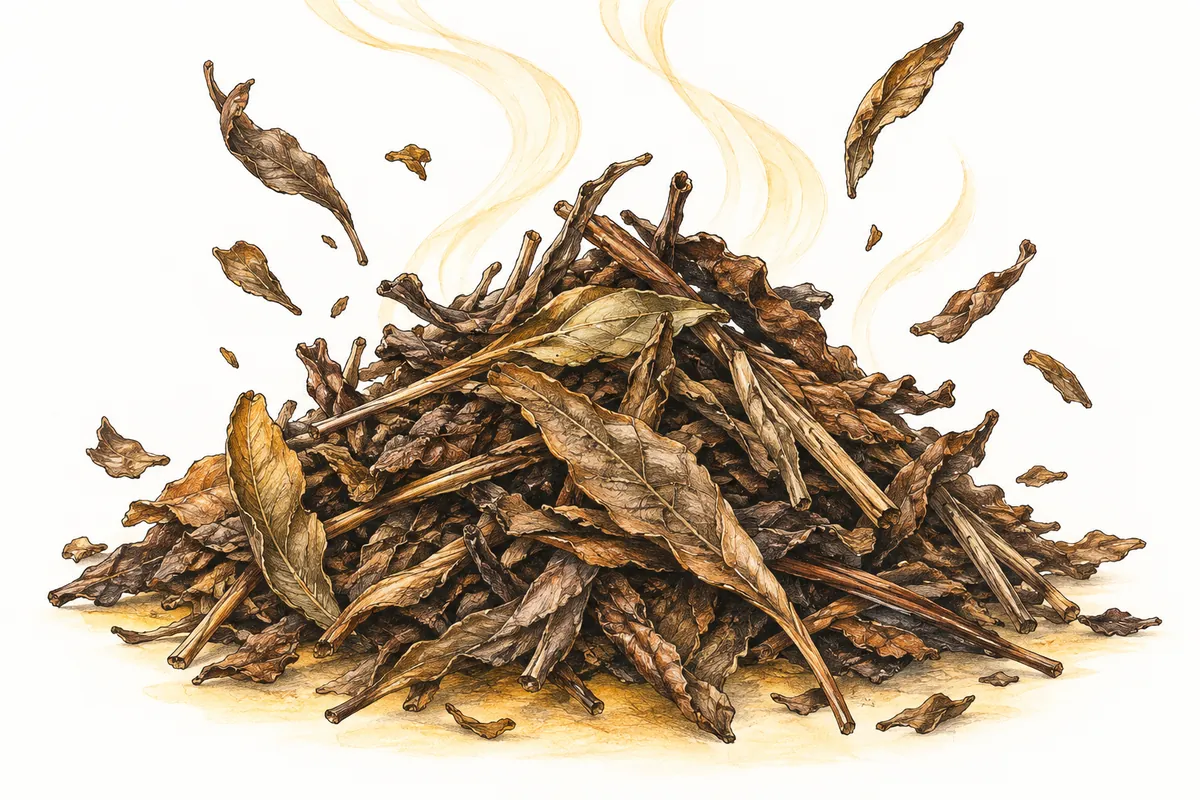
Close-up illustration of roasted tea leaves with golden lines representing the rising aroma.

Roasting and final firing use the same heat but are different steps; here is where the line falls, in temperature and in time.

01Members only

Teas separated by name, rearranged by process

Hojicha is green tea made by roasting sencha or bancha. Hojicha names a process, kukicha the part of the plant, genmaicha an added ingredient.

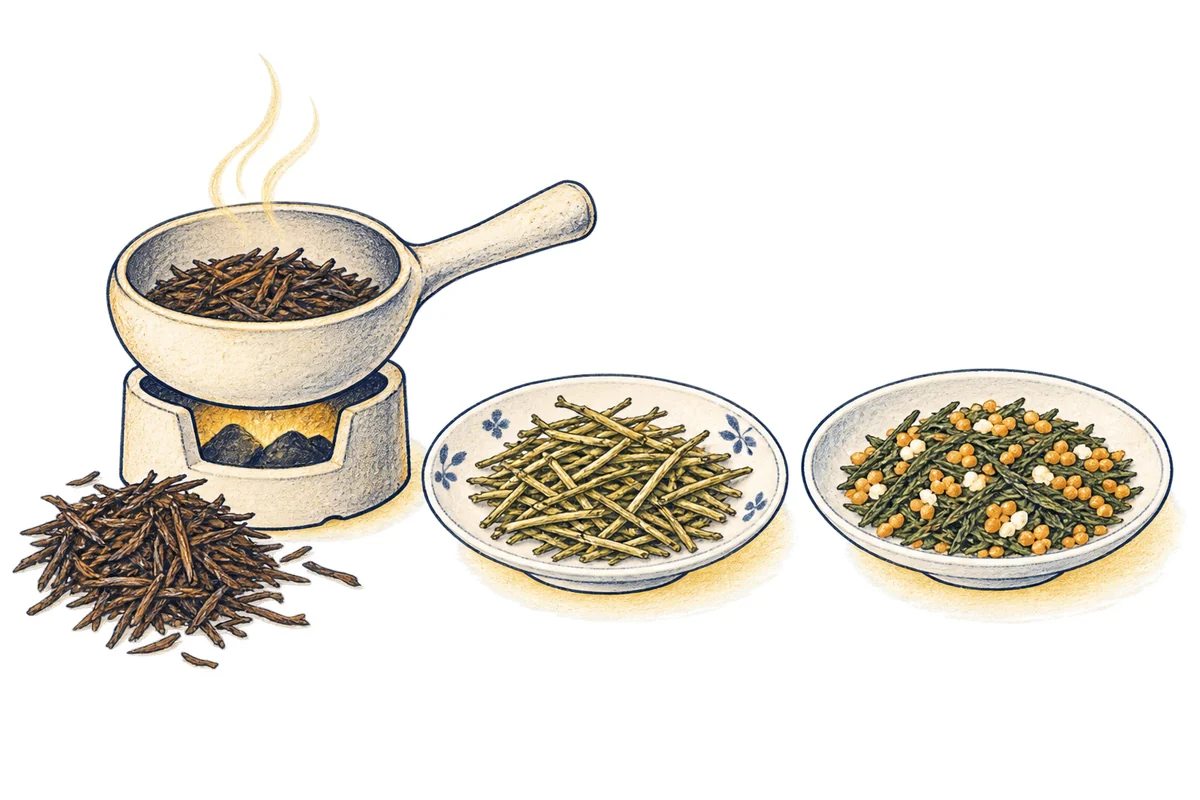
Illustration of tea leaves being roasted beside the ingredients of stem tea and genmaicha.

“Hojicha” and “stem tea” are not mutually exclusive names. Roast tea stems, and one tea can fit both descriptions. Japanese tea names mix descriptions of how a tea is made with descriptions of the part of the plant used.

Let’s follow hojicha, kukicha and genmaicha back to their ingredients. Once you understand the differences, the name alone can help you picture a little of what is inside an unfamiliar product.

What is hojicha? A green tea made by roasting sencha or bancha

Hojicha is a green tea made by roasting sencha, bancha or similar teas. Its appearance changes, but it does not become a different kind of tea. The name points at one thing only: that roasting was added after the green tea had been made.

The three names point at different things: hojicha at a process (roasting), kukicha at a part of the plant (the stems), and genmaicha at an added ingredient (roasted rice). Because these are different layers, roasted stem tea is both hojicha and kukicha; the two names are not alternatives. A packet can then be read in order: what tea it started from, leaves or stems, and whether it was roasted or combined with something else.

Japan’s Ministry of Agriculture, Forestry and Fisheries describes hojicha as a green tea made by roasting sencha, bancha or similar teas. Green tea is made first, and roasting adds a further processing step. The tea remains in the green-tea family even though its appearance changes.

The early heating used in making green tea stops the activity of enzymes in the leaves. Roasting to make hojicha comes at a different stage. Knowing only that heat was applied does not tell you which step is being described.

Kukicha names a part of the plant, not a process

The definitions used here come from the pages introducing Japanese tea published by the Ministry of Agriculture, Forestry and Fisheries, which set out which process or plant part each name points to. A particular product’s roast level, or where its tea was grown, is not something those pages cover.

The ministry describes kukicha, or stem tea, as tea made from the stems of gyokuro or sencha. Where “hojicha” points to roasting, “kukicha” points to the part of the plant used.

You can ask two separate questions: does this tea use stems, and has it been roasted? The word kukicha alone does not answer the second question, which is why the product description matters. Conversely, finding slender stems in a packet of hojicha is entirely consistent with its name.
The remaining two sections cover what roasting refers to in genmaicha as against hojicha, and the order of three questions — which tea, leaves or stems, roasted or combined — that reads a single packet.

The rest of this article is for members.

Membership is available in Japanese. It takes an email address and a password, and it is free.

Open the Japanese membership page

Updated 22 September 2026This section on its own page

02Members only

How amino acids and sugars turn into aroma under heat

Roasting creates hojicha’s aroma from the amino acids and sugars in the leaf. In an Ishikawa study at 180°C to 220°C, pyrazines rose as catechins fell.

Close-up illustration of roasted tea leaves with golden lines representing the rising aroma.

Bring a cup closer and the aroma of hojicha rises towards you. We usually make do with calling it “roasty”, but many of those aromas were newly created when heat was applied to the tea.

Researchers at an institute and a university in Ishikawa studied stem tea roasted between 180°C and 220°C. The National Agriculture and Food Research Organization (NARO) also reports on the individual compounds behind roasted tea’s aroma. Reading the two together makes the changes taking place during roasting more tangible.

What happens inside the leaf when hojicha is roasted?

When tea is roasted to make hojicha, heat drives a reaction between the amino acids and sugars in the leaf, creating aromas the original green tea did not have. Nothing is added. The same heat reduces the catechins and amino acids that made the green tea’s taste.

Three things happen in the heat. The reaction that forms pyrazines from amino acids and reducing sugars is the Maillard reaction, and it proceeds further as temperature rises. Geraniol and linalool, held in the leaf bound to sugars, increase as heating releases them. And catechins and amino acids fall rapidly at the same time, so roasting develops aroma and loses taste components together.

The Japanese Tea Instructor Association’s introduction explains hojiru as heating food in a pan or similar vessel until moisture is lost, or exposing it to heat and scorching it. Hojicha is made by roasting sencha, bancha or similar teas at high heat; it does not require a special ingredient.

The Ministry of Agriculture, Forestry and Fisheries also describes hojicha as sencha or bancha roasted over strong heat, characterised by a distinctive toasty aroma and a light, clean feel as it is swallowed. Rather than adding something, this is a process of using heat to change what is already in the tea.

Heat turns amino acids and sugars into aroma

The figures in this article come from two reports. One is the stem-tea study by the Industrial Research Institute of Ishikawa and Ishikawa Prefectural University, which roasted Yabukita first-flush stems in a drum roaster and states its conclusion explicitly “within the range of 180°C to 220°C”. The other is NARO’s report, which compared three samples taken as the surface temperature of the tea reached 100°C, 115°C and 130°C. Both describe particular materials and conditions, not figures that can be applied to every hojicha.

The study of stem-tea roasting explains that roasting produces volatile compounds from the amino acids and sugars in green tea. The reaction that forms pyrazines from amino acids and reducing sugars is known as the Maillard reaction. Its rate depends on temperature, so the reaction proceeds further as the roasting temperature rises.

Citing earlier research, the paper states that roasted tea contains more than a hundred volatile compounds, with pyrazines among the principal compounds shaping its aroma.

Pyrazines are not the only aroma compounds that develop. Geraniol and linalool occur in green tea in forms bound to sugars; the paper reports that their amounts increase when heating releases them from those bonds. Floral aromas, as well as roasted ones, can therefore increase during roasting.

The remaining five sections cover what changed at 180°C, 200°C and 220°C, what declines while aroma develops, the eight words that separate out a roasty smell, and how hiire differs from roasting.

The rest of this article is for members.

Membership is available in Japanese. It takes an email address and a password, and it is free.

Open the Japanese membership page

Updated 22 September 2026This section on its own page

03Members only

Oolong and black tea are fired again after they have dried

In the Dong Ding oolong described by Taiwan’s research station, roasting follows drying — for moisture, storage life and green notes, not just aroma.

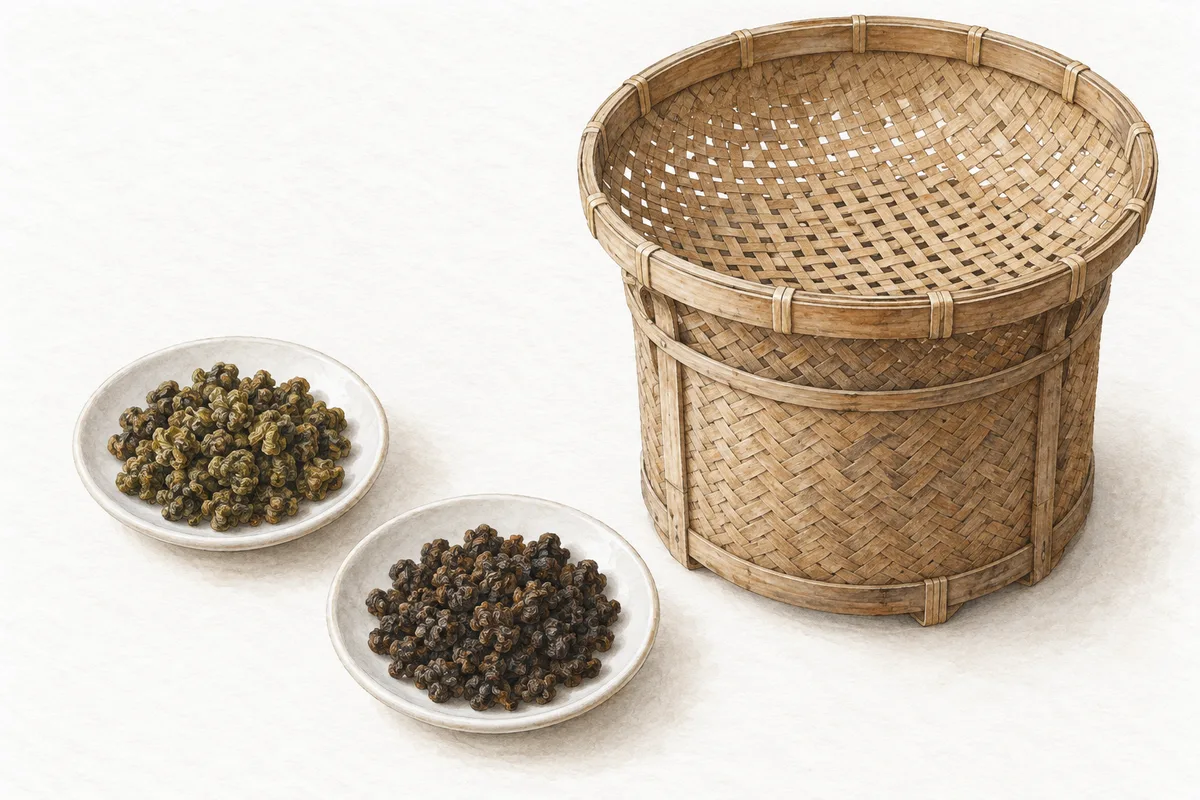
An illustration of rolled oolong leaves on two small white dishes, one lightly roasted green-brown and the other deeply roasted dark brown, beside a woven bamboo roasting basket.

Arranging green tea, oolong, and black tea by their degree of oxidation helps organise tea categories. Yet it does not fully explain aroma differences within oolong. Japan’s Ministry of Agriculture, Forestry and Fisheries also describes oolong as having varied tastes and aromas according to degrees of partial oxidation and roasting. Let us consider finishing heat as a separate dimension alongside oxidation.

Why is oolong roasted after it has already been dried?

In the Dong Ding oolong process described by Taiwan’s research station, a roasting stage follows drying. Its purpose is not only to add aroma: removing moisture again, extending storage life and correcting green notes and unwanted flavours in the initially processed tea belong to the same stage. Unroasted qingxiang versions also exist, so the name of a tea does not settle it.

The sources set out three things. Taiwan’s research station lists drying and roasting as separate stages. The functions given for roasting are removing moisture again, extending storage life, correcting green and unwanted notes, and giving the tea its characteristic roasted aroma and flavour. And ball-shaped oolong is also sorted into qingxiang and beixiang styles, a roasting-related grouping separate from oxidation categories.

The Dong Ding oolong process described by Taiwan’s Tea and Beverage Research Station, Ministry of Agriculture, proceeds through sun withering, indoor withering and agitation, heat fixation, initial drying, ball rolling, drying, and then roasting. In this example, drying and roasting are listed as separate stages.

Ito En’s explanation of oolong production says the drying stage slowly dries the tea and adds a little fired aroma. Heating cannot be read simply as the removal of water. We need to look at the stage and purpose for which heat is applied.

Roasting serves more than aroma

The accounts used here are from the Tea and Beverage Research Station of Taiwan’s Ministry of Agriculture, Ito En’s description of oolong production and the specialist shop HOJO. Each defines the tea and the process it covers, then sets out where roasting sits and what it does. None gives a temperature or a time, so they cannot be set against Japanese hojicha roasting conditions on equal terms.

The Taiwanese research station lists several functions of roasting: removing moisture again, extending storage life, correcting green notes and unwanted flavours in initially processed tea, and giving the tea its characteristic roasted aroma and flavour. Preparing the tea’s condition for completion and creating flavour are described together.

A tea described as roasted therefore has not necessarily been made solely to develop a strongly browned colour or roasted aroma. Reading what material is being finished and its starting condition reveals a wider range of reasons for heating.

The remaining three sections cover what the qingxiang and beixiang categories are useful for, including teas of the same name left unroasted, how to compare oolong with hojicha, and how to read hongbei on a bag.

The rest of this article is for members.

Membership is available in Japanese. It takes an email address and a password, and it is free.

Open the Japanese membership page

Updated 22 September 2026This section on its own page

2 more sections will follow.

Back to the contents