Japan Hojicha AssociationJapan Hojicha Association

Tea gets more interesting with roasting.

One word, different teas: what 'hojicha' means region by region

Chapter 10 · 2 of 4 sections readable now

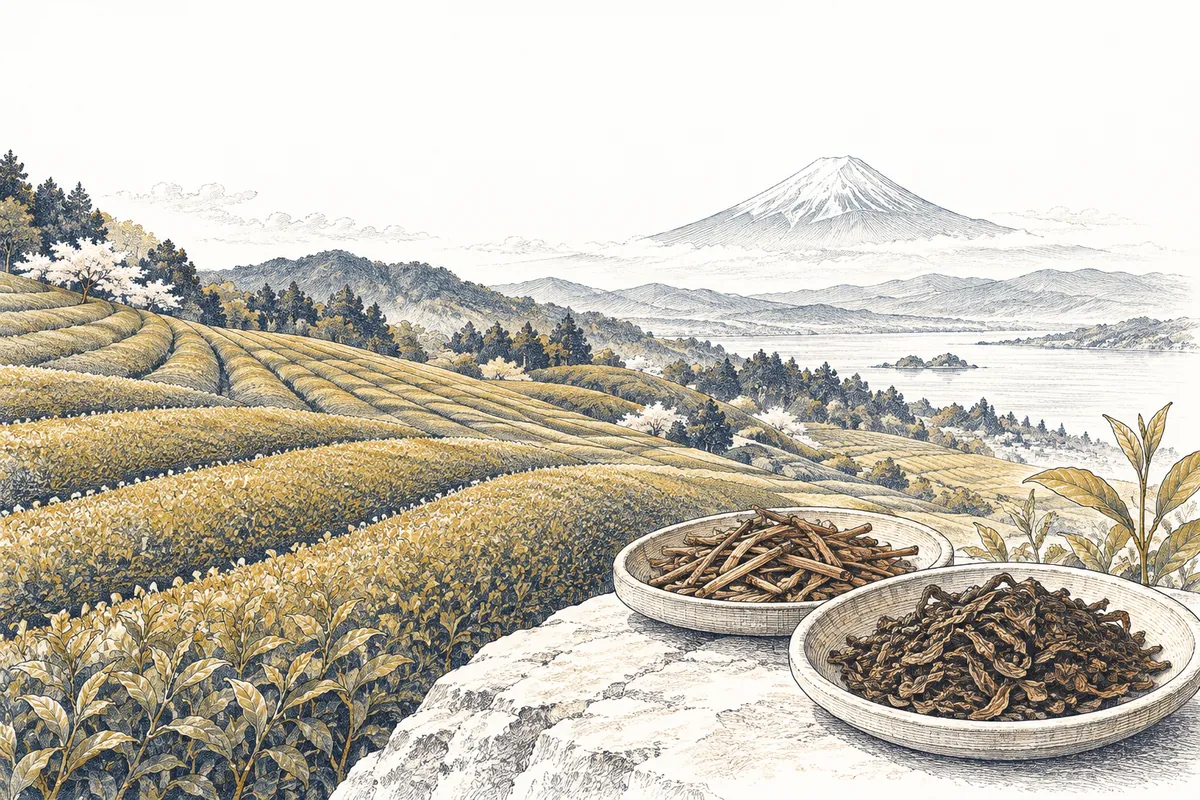
An illustration of tea-field rows with Mount Fuji in the distance, alongside two trays holding tea stems and leaves.

How the single word 'hojicha' points to different teas in Kaga, Fuji, Kyushu and Sayama.

02

Fuji: a hojicha a city turned into a brand

Fuji City, in Shizuoka Prefecture, says its tea and roasting differ from farm to farm. Rincha, founded by four farms, starts by selecting stems.

An illustration of tea-field rows with Mount Fuji in the distance, alongside two trays holding tea stems and leaves.

The name “Fuji hojicha” does not stand for just one roasting method. Fuji City explains that tea farmers and merchants use different kinds of tea and different roasting methods, offering a wide variety of hojicha.

As one example, we look at Rincha, a brand created by four tea farms at the foot of Mount Fuji. Rather than defining a single flavour for the whole region, we follow one brand’s choices from selecting its materials to roasting them.

Is there a set way of roasting Fuji hojicha?

The name “Fuji hojicha” does not contain one roasting method. Fuji City, in Shizuoka Prefecture, explains that tea farmers and merchants use different kinds of tea and different roasting methods, offering a wide variety of hojicha. Choosing a region and choosing a product are separate steps.

The short answer has three parts. Products carrying the same regional name need not share materials or finishing. Rincha, founded by four tea farms at the foot of Mount Fuji, says it repeats the usual sorting many times and uses carefully selected stems to bring out their aroma. And its roasting is described as far-infrared heat in a special machine, taking time over small quantities for an even finish.

The diversity Fuji City describes comes from differences in the tea and roasting methods used by each farmer or merchant. Products bearing the same regional name do not necessarily use identical materials or finishing processes.

Choosing a region and choosing a product are connected but separate steps. Once Fuji has caught your attention, reading the producer’s name helps you see what to compare next.

Rincha, founded by four farms, starts by selecting stems

What we read here are two accounts: Fuji City’s, and Nippon Chachacha’s published description of Rincha. Fuji City describes the variety across the area, while Nippon Chachacha describes how its own brand is made. One brand’s method is best not read as standing for the whole region.

Nippon Chachacha introduces Rincha as a hojicha brand established by four tea farms working together at the foot of Mount Fuji. The company says it repeats the usual sorting process many times and uses carefully selected stems to bring out their aroma.

It is easy to focus on machinery or temperature when reading about roasting. Here, work also goes into sorting before heat is applied. Reading what is selected for the machine, as well as how it is roasted, connects the material to the process.

How heat is applied, and how much is roasted at once

The company says it uses a special machine and far-infrared heat to roast the stems slowly through to their centres. It also says it takes time to roast small quantities at a time, aiming for an even finish.

“Far-infrared” describes how heat is applied; “small quantities” describes the amount handled. Neither term alone explains the brand’s entire method. The finished tea comes from several choices made together.
Updated 22 September 2026This section on its own page

03Members only

Kyushu, Sayama, Shizuoka: firing customs differ by region

Yame, Ureshino, Kagoshima: Asanoen roasts to order in small batches, Ureshino Chadoki’s Homura brews at about 70°C, Sakanoue Seicha uses stems alone.

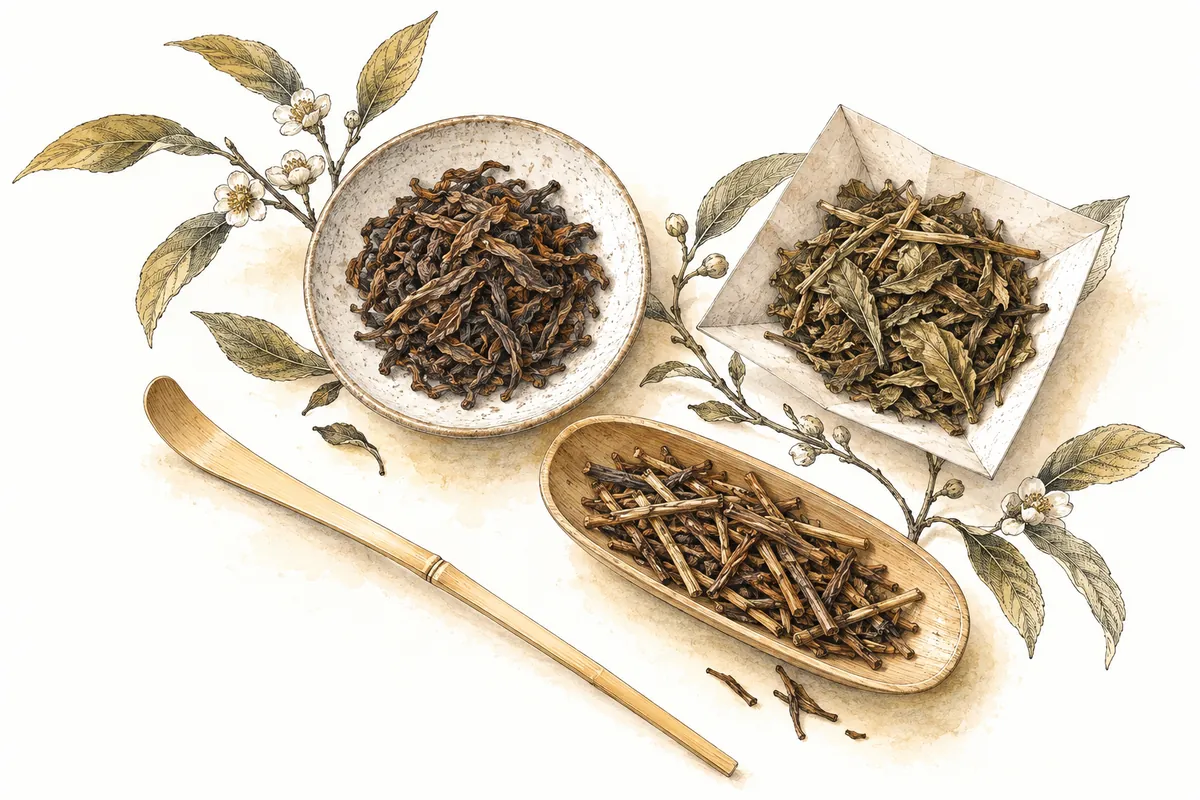
Overhead illustration of tea leaves and stems arranged in three differently shaped vessels

Yame, Ureshino and Kagoshima: consider the hojicha found in shops in these three places as individual product choices, rather than a ranking of regional flavours.

Roasting to order, recommending a brewing method closer to green tea, or selecting only stems—notice what each maker explains in detail, and the broad label “Kyushu hojicha” opens into different starting points.

What differs between Kyushu’s hojicha teas? Three packets from Yame, Ureshino and Kagoshima

The three hojicha teas of Yame, Ureshino and Kagoshima read as individual product choices rather than a ranking of regional flavours. Batch size and the timing of delivery, a brewing method closer to green tea, and a material limited to stems: what each shop explains in detail lies on a different axis.

Take the three in turn. Ocha no Asanoen in Yame says it roasts slowly in small batches at as low a temperature as possible, in response to orders, so the tea ships freshly roasted. Homura, an ao-hojicha — literally a “green hojicha” — introduced by Ureshino Chadoki, uses carefully selected first-flush tea and is recommended for brewing at about 70°C. Sakanoue Seicha’s premium hojicha in Kagoshima is house-roasted from stems alone, called shiraore or karigane, with no leaves mixed in.

Ocha no Asanoen’s house-roasted premium hojicha is roasted slowly, in small batches and at as low a temperature as possible, in response to orders. The label gives its origin as Yame, Fukuoka Prefecture. The shop describes it as having umami as well as roasted aroma.

The stated reason for small batches is to send freshly roasted tea. Here, heating and dispatch timing are connected. It is an example of looking beyond roast level to the work that happens between an order and its arrival.

In Ureshino, the brewing method is read with the product

What we set side by side here are the product descriptions published by Ocha no Asanoen, Ureshino Chadoki and Sakanoue Seicha themselves. What the three set out in detail — batch size, brewing, the part of the plant used — differs from shop to shop, so this is not a comparison made on one scale.

The official Ureshino Chadoki online shop introduces Homura as an ao-hojicha made by Hiroshi Tanaka of Tanaka Seicha. It uses carefully selected first-flush tea and is recommended for brewing with water at about 70°C, a method closer to green tea.

The shop describes an initial toastiness followed by green-tea character and sweetness. Rather than brewing it the way you brew your other hojicha, read this product’s description and its brewing instructions together.

The remaining three sections cover checking which part of the plant Sakanoue Seicha uses, keeping a shop’s location separate from the tea’s origin, and comparing the three as product choices rather than regions.

The rest of this article is for members.

Membership is available in Japanese. It takes an email address and a password, and it is free.

Open the Japanese membership page

Updated 22 September 2026This section on its own page

2 more sections will follow.

Back to the contents