Japan Hojicha AssociationJapan Hojicha Association

Tea gets more interesting with roasting.

Making different cups from the same leaves

Chapter 3 · 3 of 4 sections readable now

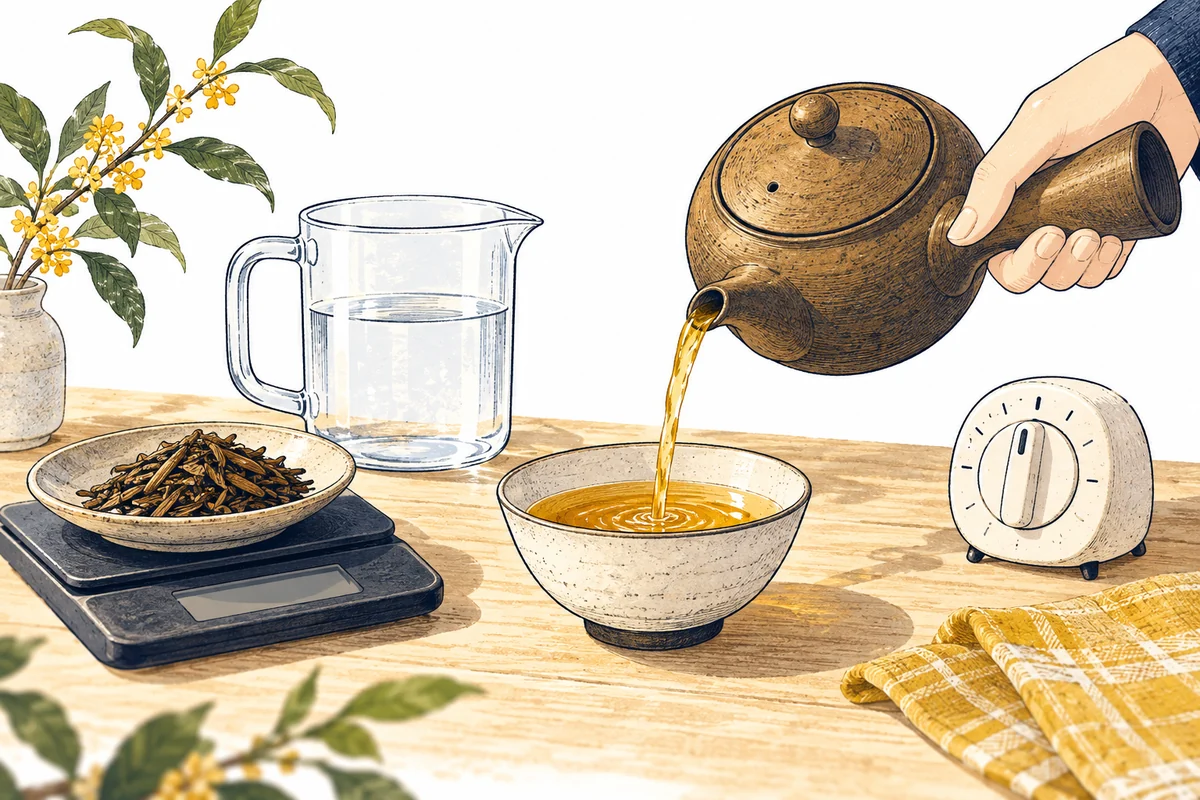
Illustration of a teapot, tea, scales and a timer used to check brewing instructions

The same leaves make different cups once you change the water temperature and the time; here is how.

01

Who decided on '90°C for 60 seconds', and how?

Read the waiting time together with tea quantity, water volume and temperature. Two product guides show how to approach the tea in front of you.

Illustration of a teapot, tea, scales and a timer used to check brewing instructions

Are instructions saying “25 seconds” and “30 seconds” only five seconds apart? Set out the tea and water quantities too, and other differences appear. Waiting time is just the final item in a recipe.

Let us reread the official brewing instructions from Maruhachi Seichajo and Ippodo Tea in the order of preparing a cup.

Before the 25 seconds come 6 g and 260 mL

For the loose-leaf version of Kenjō Kaga Bōcha, Maruhachi Seichajo advises adding 260 mL of boiling water to 6 g of tea and brewing for 25 seconds. Tea bags have a separate method, so match the format as well as the product name.

Remembering only the 25 seconds, then substantially changing the tea quantity or using a different water volume, creates different conditions from the original method. What you are trying to follow is the whole sequence from preparing the tea and water, not just the wait.

Before the 30 seconds come 10 g and 240 mL

Ippodo Tea’s Gokujo Hojicha uses 10 g of tea with 240 mL of water at 100°C, brewed for 30 seconds. Timing starts when you begin pouring the water.

Compared with the Kenjō Kaga Bōcha example, this uses more tea and less water. Looking only at the time difference hides both of those changes. The teas themselves are also different, so a difference in the finished taste cannot be explained solely as the effect of five seconds.

Expressed as tea per 100 mL of water, the first method uses about 2.3 g and the second about 4.2 g. These are values calculated from the original quantities for comparison, not new recipes for brewing these smaller amounts. They show that, alongside a difference of just five seconds, the tea-to-water proportions differ substantially.

General guidance and product instructions serve different purposes

The Ministry of Agriculture, Forestry and Fisheries gives a general guide of 90–100°C and 30 seconds to 1 minute for teas including hojicha. Guidance with a range like this serves a different purpose from instructions for a particular product.

A general guide is an introduction to brewing. When you are about to brew a product you already have, instructions matching its format and quantities provide a concrete starting point. Slightly different figures do not necessarily mean that one set is wrong.

Research also treats tea quantity and time as separate factors

A study of deep-steamed sencha found that changing the tea quantity, infusion time or number of infusions changed component quantities and taste-sensor readings. This was a study of a particular sencha, not a finding of the best brewing time for hojicha.

The approach of treating quantity and time as separate factors is nevertheless useful when comparing recipes. Measuring the intensity of a taste and deciding whether you like that taste can also be considered separately.
Updated 21 September 2026This section on its own page

02

A different roast wants a different temperature and time

Boiling water for one light roast, about 80°C for one deep roast: two examples show why tea quantity, water volume, temperature and time need to be read together.

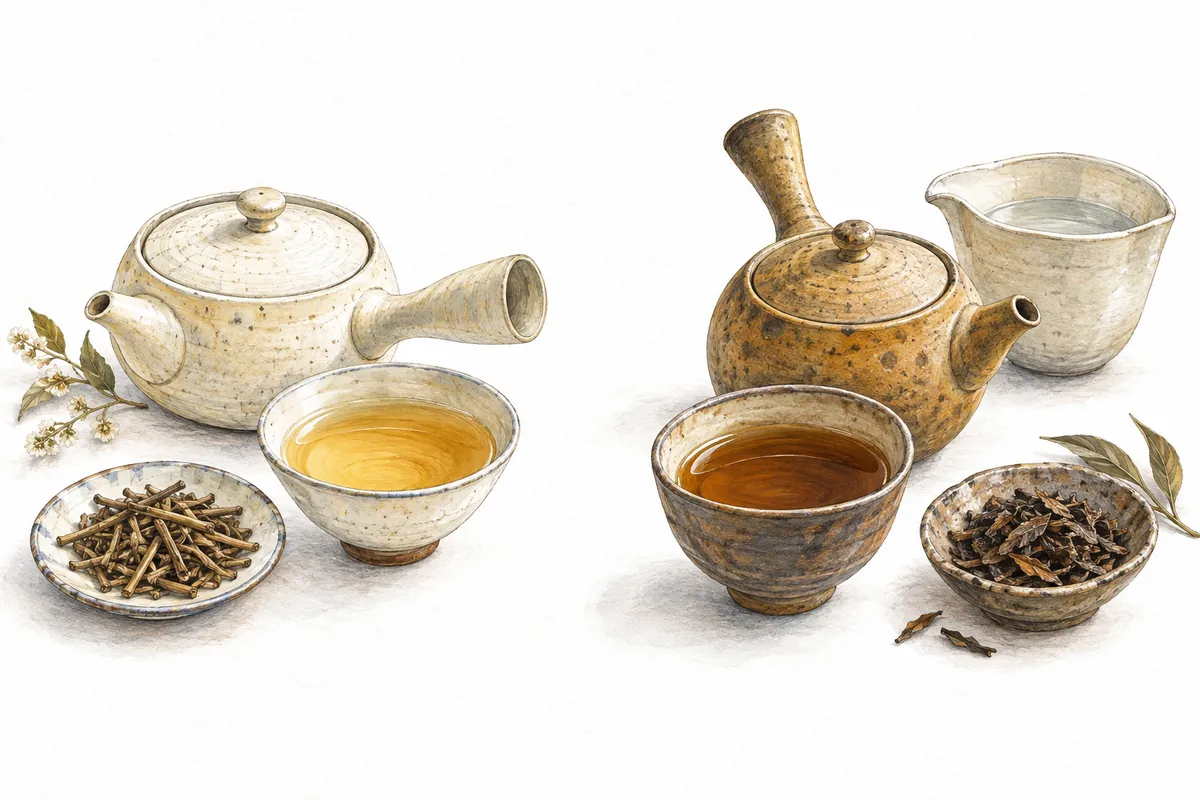
Illustration of two teapot-and-cup sets containing lighter- and darker-coloured tea

Cooler water for a light roast, hotter water for a deep roast—it is a tempting rule, but actual product instructions include the reverse. Kenjō Kaga Bōcha uses boiling water for 25 seconds; Minocamo Chaho’s direct-fire deep-roasted hojicha uses water at about 80°C for 1 minute. Read the two examples without taking temperature out of its context.

For Kenjō Kaga Bōcha, set the quantities before the short wait

Maruhachi Seichajo’s Kenjō Kaga Bōcha is made by lightly roasting stems from the first harvest. Its loose-leaf guide for 2 people uses 6 g of tea, about 3 tablespoons, and 260 mL of boiling water, with an infusion time of 25 seconds. These quantities are for loose tea; use the separate instructions for the same brand’s tea bags.

The short 25-second wait is not the whole recipe. Tea and water quantities also make up the cup described. Filling your usual teapot with water and timing only 25 seconds does not reproduce those conditions—an important point when reading the instructions.

The direct-fire deep roast has two separate one-minute waits

Minocamo Chaho’s direct-fire deep-roasted hojicha uses tea stored at low temperature for one year before being slowly roasted deeply. Its method begins by pouring about 180 mL of thoroughly boiled water into a separate vessel, such as a teacup, and waiting about 1 minute for it to cool to roughly 80°C.

Meanwhile, put 2 teaspoons, about 5 g, of tea in a teapot. When the steam has become gentler, add the water and wait 1 minute. The first minute cools the water; the second infuses the tea. They start at different points. Treat the cooling time as this product guide’s estimate, not a guarantee that every vessel reaches the same temperature.

Light and deep do not explain every difference

The products differ in their materials as well as roast level, and their tea and water quantities also differ. This comparison therefore cannot establish the reverse rule that light roasts need hot water and deep roasts need cooler water. What it shows is the need to read each product’s specified conditions.

This is not an experiment that changes only roast level in the same raw material. It compares brewing methods that shops provide for their respective teas. Instructions for making a particular product taste good and a trial isolating roast level’s effect have different purposes.

When adjusting towards your taste, record what you changed

Start by brewing as the product instructs. If you try a change next time, note whether it was tea quantity, water volume, temperature or infusion time; this helps you recall its relationship to the previous cup. Changing everything at once makes it harder to know what helped, even if you like the result more.

Record aroma, the impression in the mouth and the impression after drinking, rather than only “good” or “bad”. Keeping a stronger taste separate from a taste you like makes it possible to consider adjustments other than simply adding more tea.

Updated 21 September 2026This section on its own page

03

Lower the temperature: what comes out, and what stops coming out

Cold-brewing Kenjō Kaga Bōcha tea bags uses 2 bags in 600 mL of cold water for 3 hours. Both quantities and timing differ from hot brewing.

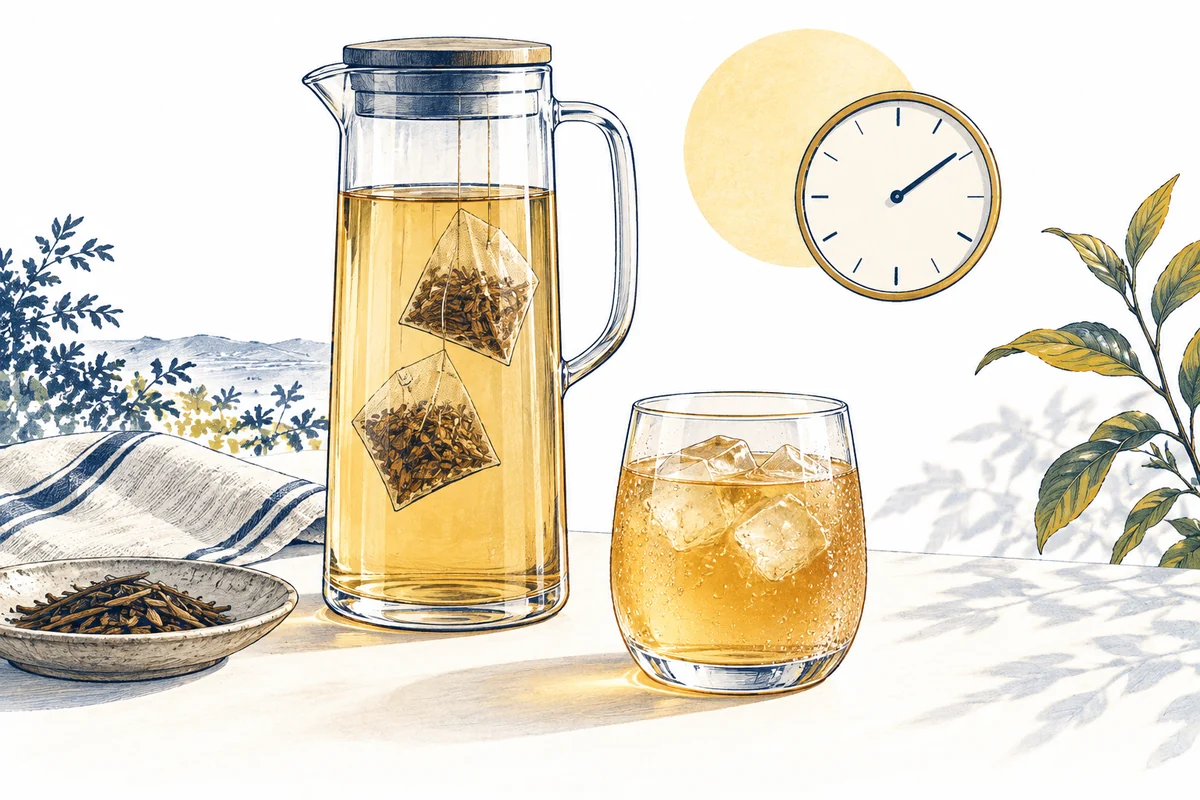
Illustration of a cold-brew pitcher holding tea bags and a glass of cold hojicha

Cold hojicha can be made by slowly infusing tea in cold water, or by brewing it with boiling water and cooling it over ice. Both produce a cold drink, but the tea’s contact with water follows different paths.

Here are Maruhachi Seichajo’s cold-brew tea-bag instructions and Ippodo Tea’s recipe for cooling tea over ice: one cup that waits, and another brewed hot before it is chilled.

Cold brewing: 600 mL of cold water for 3 hours

Maruhachi Seichajo recommends 2 Kenjō Kaga Bōcha tea bags with 600 mL of cold water, infused for 3 hours. Each bag contains 3 g, making 6 g of tea in total.

The company describes the roasted aroma in this cold brew as even clearer than in hot tea. This is the seller’s description of this particular product’s flavour. It presents cold brewing as a way to enjoy another impression of the aroma, rather than simply a replacement for hot tea.

The same tea bags use different proportions for a hot cup

The hot-brewing method for this product uses the same 2 bags with 260 mL of boiling water for 45 seconds. Cold brewing combines the same tea quantity with more than twice as much water and takes 3 hours instead of 45 seconds.

The bag count is the same, but the combination of volume and time is very different. The cold-brew instructions form a complete method, rather than simply replacing the hot water with cold water in the hot-brewing recipe.

Another cold tea begins with boiling water and ends over ice

Ippodo Tea’s Iced Hojicha recipe uses 10 g of tea with 240 mL of boiling water at 100°C, infused for 60 seconds without stirring. Prepare plenty of ice, then pour all the brewed tea over it to cool.

This is not an infusion in cold water. Brewing with boiling water and then cooling over ice means that the brewing water and the cooling ice have separate roles. Melted ice also adds water to the drink, so 240 mL should not be read as its finished volume.

Look beyond “iced” to the brewing method

Waiting with cold water, or pouring a hot infusion over ice: both can be called iced hojicha, but they take different time and equipment. Choose by the process—cold brew if you are preparing ahead, or have ice ready if you want to brew hot and cool the tea.

These two official recipes use different products and formats. Follow the chosen method without swapping ingredients or quantities partway through. When comparing them, enjoy each as a cup made by its recipe, rather than attributing every difference you notice to temperature alone.

Updated 21 September 2026This section on its own page

1 more section will follow.

Back to the contents