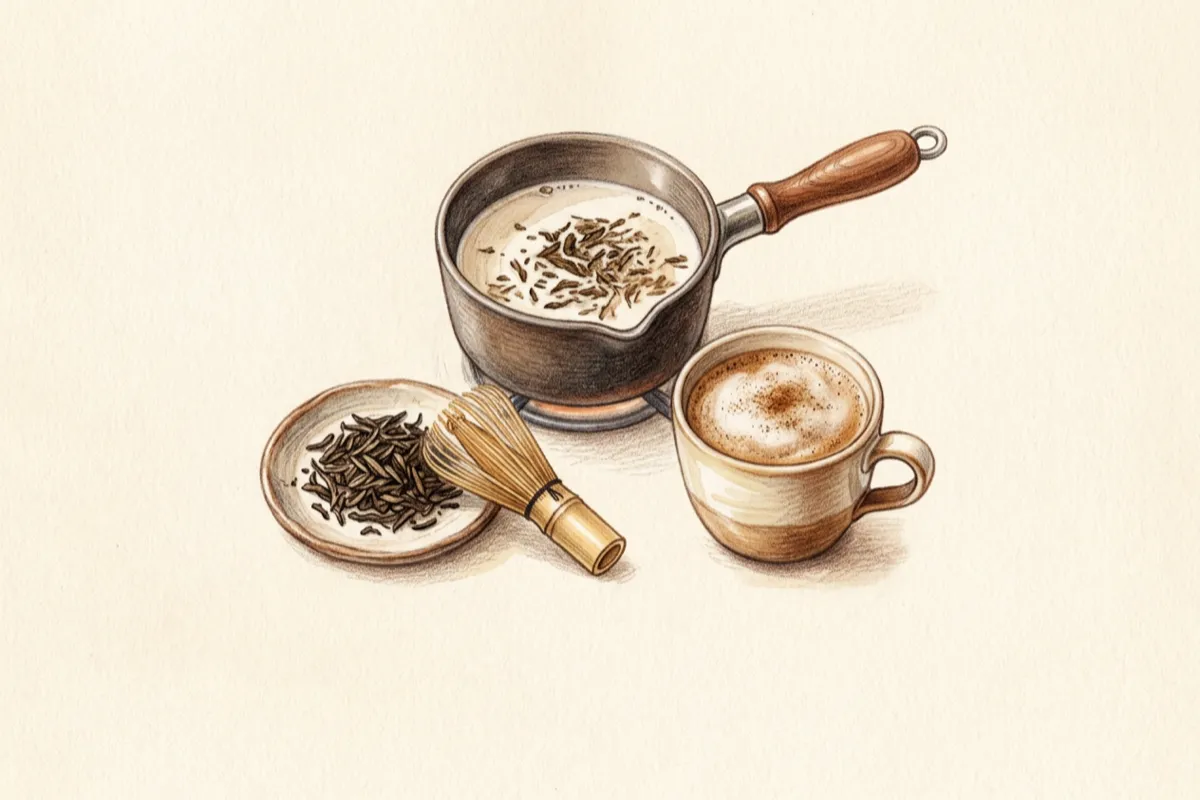
On the side of a milk carton is a box marked type. It is in sight every day and rarely read when buying. In the kitchen there is a teapot, a small pan and a whisk, and the copied-out recipes mix tablespoons with cc. With that much to decide, the hands usually move in whatever order things occur to them.
The cup that comes out is fine. The trouble starts the next time it has to be made. What follows looks at what to settle first to get back to the same cup: ratio, strength, the label on the milk, and heating.
The ratio comes first
Pour milk into a measuring jug and the white lines of the scale waver. What gets settled first is not the leaf or the roast depth, but the share of milk.
Decide what share of the cup is milk, then build a strength of tea to fit. In that order, each change can be followed one at a time.
Which share tastes best is not something the recipe numbers settle. After the ratio comes how it relates to strength.
Strength and ratio, separate dials
Leave tea standing in the pot and its colour slowly deepens. Strength of tea and share of milk are separate dials.
In the published recipes, as the piece comparing café and home cups showed, milk ranges from a splash to nearly the whole cup. A cup meant to come close to the café sits on the milky side, hojicha with a little milk on the other. Until the aim is settled, the ingredients cannot be.
Nor does brewing stronger necessarily bring the café closer. A bōcha shop's latte is more than twice the strength the same shop gives for everyday brewing, yet keeps the milk low. After strength comes the milk itself.
What may be called milk
Turn a carton from the fridge and small print runs down the side. If the type box says milk, it is raw milk only, with nothing adjusted.
According to a dairy industry body, only raw milk above set levels of milk fat and non-fat solids may be called milk. Low-fat milk, non-fat milk and milk drinks are each defined separately. For a day aimed at the café's impression, a carton whose type box says milk is the place to start.
One convenience store's hojicha latte is also described as finished with raw milk only. The sources go as far as the labelling rule and that description. After the carton comes heating in the pan.
Just before the skin forms
As milk warms in the small pan, a thin skin begins to form. Heating can be thought of with that skin as the boundary.
Like yuba slowly thickening, the skin on milk thickens with the time and heat. A dairy association explains that it starts to form above forty degrees, and that the first skin is mostly fat. A home recipe's whisking up to just short of boiling is also a way of keeping the heat from gathering in one place.
A fork will do for a whisk, a small saucepan for a milk pan. Dedicated equipment matters only for matching the café's speed. Warmed milk tasting sweeter is not a matter of more sugar. Sweetness other than fructose is said to be felt more strongly near body temperature.
The sources go as far as how temperature, skin and sweetness relate. Last comes plant-based milk.
Oat milk for baristas
At the end of the shelf stand cartons of oat milk. Those marked for baristas are described as having been tested for how readily they foam.
The criteria given are ease of foaming, fineness of foam and stability. The description says nothing about how it behaves with tea.
How it suits tea comes up again under blending. The figures and labelling rules are gathered just below. The milk in the small pan settles, leaving small bubbles at the rim.
The numbers in detail
- Share of milk
- The share of milk in published recipes runs from 20% to over 80%.
- Bōcha latte
- The bōcha shop's latte is Maruhachi Seichajo's bōcha latte. It works out at 5.6 g of leaf per 100 mL, with milk held at 20%.
- Packet brewing
- The brewing the company prints on the Kenjō Kaga Bōcha packet is 6 g to 260 mL of boiling water for 25 seconds (2.3 g per 100 mL). The latte is about 2.4 times that strength; the conversion and multiple are calculated from the printed figures.
- Labelled milk
- According to J-Milk, the type milk means 100% raw milk, unadjusted, with at least 3.0% milk fat and 8.0% non-fat milk solids.
- Other types
- Low-fat milk is 0.5–1.5% milk fat, non-fat milk under 0.5%, and a milk drink at least 3.0% milk solids.
- 100% raw milk
- The latte described as finished with 100% raw milk is Lawson's Machi Café hojicha latte.
- Milk skin
- The Japan Dairy Association explains that a skin forms at 40°C and above, the first skin over 70% fat and 20–25% protein. It thickens in proportion to heating time and temperature.
- Heating and sweetness
- Heating to just before boiling while whisking is Ito En's recipe. The explanation of sweetness and temperature is also the Japan Dairy Association's.