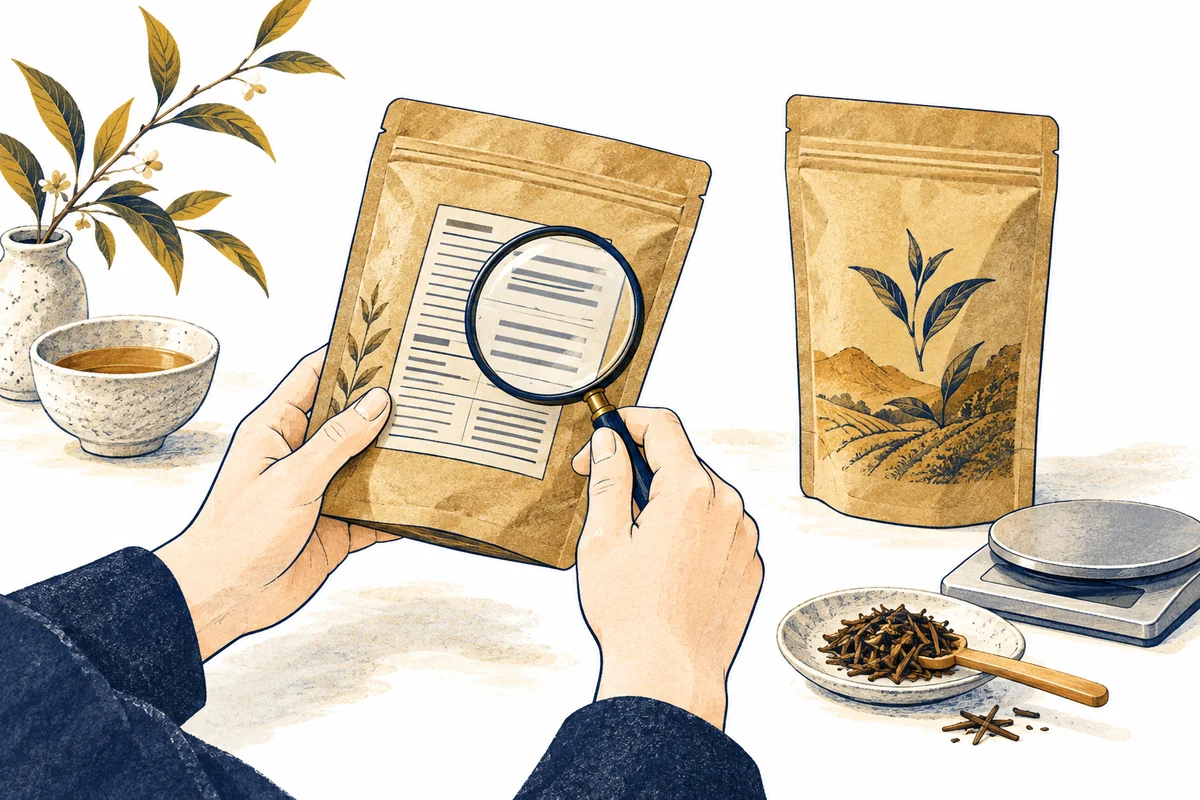
“Green tea (Japan)” and “60 g” on the back of a packet describe the same tea but answer different questions. The first concerns the ingredient; the second is the total quantity in the packet. Read on to the brewing instructions and another figure appears: how much to use at once.
Rather than simply scanning the label from top to bottom, separate the types of information. Actual products from Ippodo Tea and Maruhachi Seichajo provide examples.
What “Japanese-grown” tells you—and how far it goes
The ingredient label on Ippodo Tea’s Gokujo Hojicha says “green tea (Japan)”. It establishes that the green tea is Japanese-grown, but does not by itself identify the prefecture or the proportions of leaves and stems.
Knowing the tea merchant’s name or location does not let you substitute that location for the tea’s origin. Treating the shop’s location and the place where the material grew as separate information makes it clearer what to look for if you want to know the origin.
60 g and 3 g × 12 bags describe quantity differently
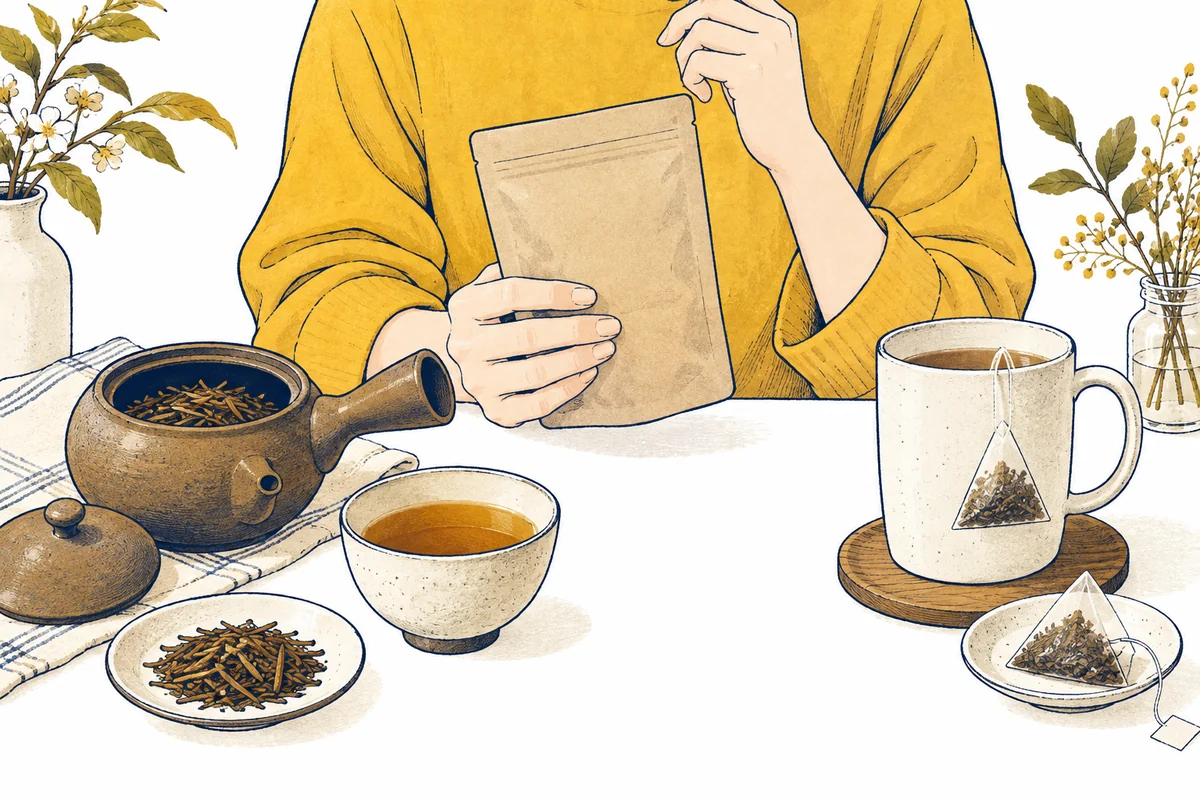
Kenjō Kaga Bōcha comes as a loose-leaf “60 g bag” and as “3 g × 12” tea bags. The 60 g figure is the quantity of tea in one packet. The 3 g × 12 description gives both the quantity in each tea bag and the number of bags.
The latter contains 36 g of tea in total. Converting the description into grams and the units they come in reveals more than comparing outer packaging or bag counts alone. Total quantity does not, however, decide convenience or your preference in taste.
The brewing instructions show how a packet will be used
The official hot-brewing instructions use 6 g of loose tea at a time, or 2 tea bags. Using 60 g in portions of 6 g gives 10 batches; using 12 bags in pairs gives 6 batches. These calculations count preparations made by the respective methods.
Calling them 10 cups and 6 cups without checking how much each preparation makes would change their meaning. To consider cup size or how many people will share the tea, distinguish the packet’s total contents, the quantity used each time and the amount of tea each preparation makes.